GCWR stands for Gross Combined Weight Rating.
In the trucking industry, the GCWR is the absolute maximum allowable weight of your entire rig combined. This means the total weight of your towing vehicle (the truck) PLUS the total weight of your loaded trailer.
Your GCWR includes absolutely everything rolling down the highway:
- The weight of the truck cab itself
- The weight of the empty trailer
- All of the freight and cargo loaded inside
- The driver and any passengers
- All engine fluids and a full tank of diesel fuel
It is the structural limit determined by the manufacturer of what your truck’s engine, transmission, axles, and brakes can safely pull and stop. If your actual combined weight exceeds your GCWR, you are operating beyond the manufacturer’s rating.
GCWR vs. GVWR: What is the Difference?
This is the number one question we get from students studying for their CDL permit tests. It is incredibly easy to confuse GCWR with GVWR, but the difference comes down to one simple word: Combined.
- GVWR (Gross Vehicle Weight Rating): This applies to a single unit. Your truck has its own GVWR (what the truck can hold). Your trailer has its own separate GVWR (what the trailer can hold).
- GCWR (Gross Combined Weight Rating): This applies to the entire combination. It is the maximum weight limit of the truck and the trailer hooked together as one moving unit.
Pro Tip: When you pull an 18-wheeler onto a DOT scale at a weigh station, the officer is checking to make sure your total weight does not exceed your GCWR!
Why GCWR Determines Your CDL Class
Why does the DOT care so much about this number? Because your GCWR directly determines what class of Commercial Driver’s License you need to legally drive the truck!
FMCSA uses GCWR for combination vehicles and GVWR for single vehicles when determining CDL group classifications.
Here is the golden rule:
You need a Class A CDL if your vehicle has a GCWR of 26,001 pounds or more, AND the trailer you are towing has a GVWR of more than 10,000 pounds.
If you are driving a heavy-duty pickup truck pulling a massive gooseneck flatbed, or a standard semi-truck pulling a 53-foot dry van, you have officially entered Class A CDL territory. You cannot legally turn the key without the proper license.
Don’t Risk Getting the Wrong License!
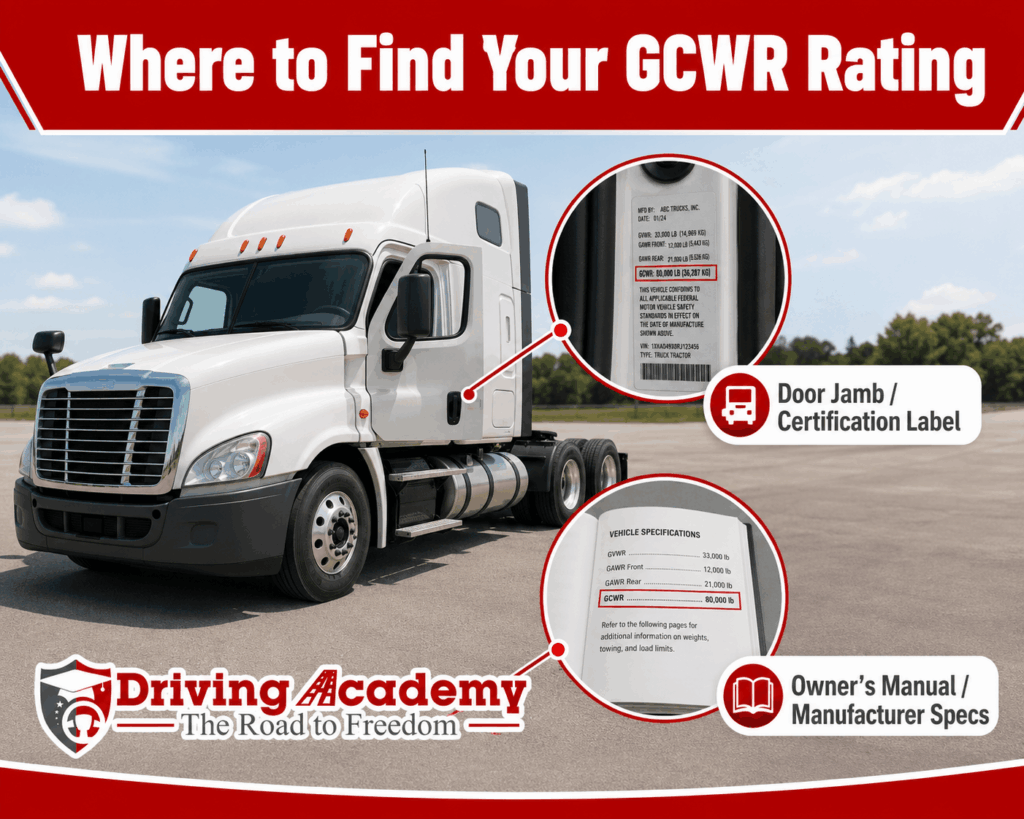
How to Find Your Truck’s GCWR
- The Door Jamb Placard: Open the driver’s side door of your commercial truck. Look for the federal compliance sticker (usually a metal plate or heavy-duty sticker) on the inside frame. It will list your GVWR, your axle ratings, and your GCWR.
- The Owner’s Manual: If the sticker is faded, you can always check the manufacturer’s manual for your specific truck’s make, model, and rear axle ratio to find the exact towing capacity and GCWR.
What Happens If You Exceed Your GCWR?
In the logistics industry, dispatchers always want to move as much freight as possible. But if you allow someone to load your truck and trailer past its Gross Combined Weight Rating, you are the one who will pay the price.
Here is what might happen when you get caught running overweight:
- Overweight Tickets: DOT weigh stations do not mess around. Overweight tickets are often calculated per pound over the limit. You could easily face thousands of dollars in fines, which go directly onto your permanent driving record.
- Placed “Out of Service”: You will not be allowed to leave the scale house. The DOT officer will place you out of service, meaning you are stuck there until another truck arrives to take the excess freight off your trailer.
- Deadly Brake Failure: Your GCWR is primarily based on stopping power. If you are hauling more weight than your rig is rated for, your air brakes will overheat and fail, especially on steep downhill grades.
- Blown Transmissions & Tires: Pulling too much weight will literally tear your truck apart, blowing out commercial tires and destroying your transmission.
FAQ: GCWR in the Trucking Industry
Lorem ipsum dolor sit amet, consectetur adipiscing elit. Ut elit tellus, luctus nec ullamcorper mattis, pulvinar dapibus leo.
Lorem ipsum dolor sit amet, consectetur adipiscing elit. Ut elit tellus, luctus nec ullamcorper mattis, pulvinar dapibus leo.