Are you a someone who doesn’t mind getting a little dirty whose looking for a career that offers incredible job security, great pay and gets you home every single night? Well driving a garbage truck can be one of the best moves you can make.
The most common question we get from students looking to get into the waste management industry is: Do garbage men need a CDL license?
The answer depends on what type of garbage man you are!
If you’re the guy filling the truck, there’s no CDL license needed because you’re not driving anything.
However, if you are the guy driving the truck, it is very likely that you’re going to need a Commercial Driver’s License (CDL).
In this garbage truck CDL guide, we are going to break down exactly which CDL class you need, the federal weight rules, the types of garbage trucks and the exact steps to get your license.
Let’s get rolling!
Are You Looking To Get Your CDL?
Why Most Garbage Trucks Require A CDL?
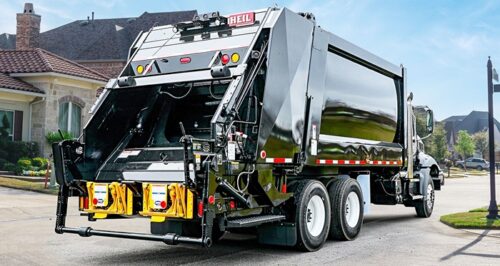
If you want to drive a standard garbage truck in your local neighborhood, you will need to get at least a Class B CDL. Here is the legal reason why:
The 26,000 Pound Rule (GVWR)
The requirement for a CDL has nothing to do with what the truck looks like, it is all about the weight. By federal law, any single vehicle that weighs more than 26,000 lbs (or is rated to carry more than 26,000 lbs) requires a CDL driver to operate it.
Garbage trucks are built on heavy-duty, rigid frames designed to hold tons of compacted trash. Even when they are completely empty, most garbage trucks easily exceed this 26,000 lb threshold, which means you are legally required to hold a CDL.
The Air Brakes Restriction
Garbage trucks are incredibly heavy, meaning they don’t typically rely on standard hydraulic brakes like your personal car. They are equipped with commercial air brakes for maximum stopping power.
If you want to drive a garbage truck, you must pass the Air Brakes portion of your CDL written exam, and you must take your behind-the-wheel road test in a truck equipped with air brakes. Otherwise, you will get an “L” restriction on your license, which bars you from driving any air-brake-equipped commercial vehicle.
Types Of Garbage Trucks
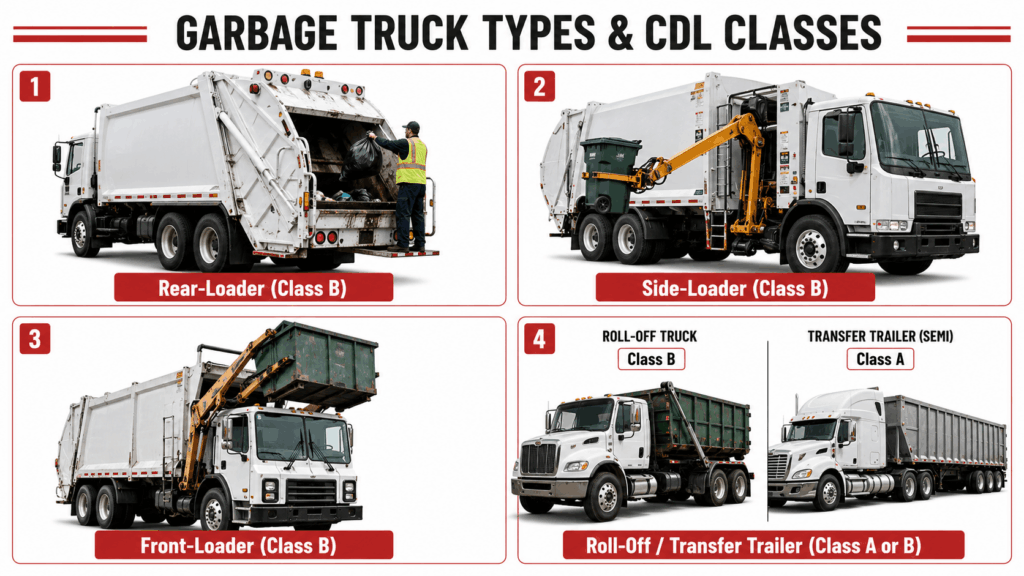
Not all garbage trucks are the same, and here is a breakdown of the vehicles in the industry and what license do you need to drive it:
- Rear-Loaders (Class B): This is the classic residential truck where the “helper” rides on the back and tosses bags into the rear compactor.
- Side-Loaders (Class B): These are highly automated trucks equipped with a robotic arm. The driver pulls up next to a specialized bin, and the arm does all the lifting.
- Front-Loaders (Class B): Primarily used for commercial businesses, these trucks have two massive hydraulic forks on the front that lift commercial dumpsters up and over the cab into the compactor.
- Roll-Off Trucks & Transfer Trailers (Class A or B): Roll-off trucks carry massive construction dumpsters. If the truck is a single rigid vehicle, a Class B is fine. However, if you are driving a semi-truck pulling a massive transfer trailer from a waste station to a landfill (and the trailer exceeds 10,000 lbs), you will officially need a Class A CDL.
Learn more about the difference between Class A and Class B CDL.
Why Driving A Garbage Truck Is An Amazing Career?
The cool thing about getting a CDL Class B license is that you don’t just have to drive garbage trucks. You can drive many other types of trucks as well, like box trucks and cement trucks.
But, that being said, the waste management industry is a goldmine. As they say, one man’s trash is another man’s treasure.
Here is why you should consider making the jump:
- Job Security: The garbage truck industry is likely to say forever. There is one thing that humans make all the time, and that is garbage! You don’t have to worry about the back-and-forth of “Am I going to have a job?” The garbage always needs to be picked up.
- Government Perks & Pensions: Many towns actually pick up their own garbage. If getting a nice government job sounds good to you, this might be one of the best avenues for you to enter the industry. You get access to things like a pension, generous vacation days, and top-tier benefit packages.
- Home Every Single Day: The hours are sweet, you get in and out, and it’s consistent all the time. Unlike Over-The-Road (OTR) truckers who sleep in their cabins, you are home every single day.
- Ultimate Comfort: It’s probably one of the easiest jobs that you can actually have as long as you can handle the stench! The cool thing about being the driver is that you can close the window, keep the AC blasting.
How Much Does a Garbage Truck Driver Make?
The average garbage truck driver is going to make anywhere from $53,000 to about $84,000 a year based on data from Glassdoor. CDL holders
However, depending on the area that you live in, we’ve seen even higher numbers for experienced drivers! It all depends on your municipality, whether you are in a union, and how much overtime you are willing to take.
If you’re ready to move into a career with stability, benefits, and daily home time, contact Driving Academy today and let us help you get your CDL.
Step Process To Get Your Garbage Truck CDL
So, if you’re interested in getting yourself a CDL Class B license, what are the steps? There’s a simple three-step process:
Step 1: Pass The CDL Permit Tests
Before you can drive a commercial vehicle, you must get your Commercial Learner’s Permit (CLP). You do this by passing written knowledge tests at your local DMV (or MVC).
To get your Class B permit, you must pass the General Knowledge test. However, because 99% of garbage trucks use air brakes, you will also need to pass the Air Brakes exam so you do not get a restriction on your license.
You can try studying for the permit test on your own. But lots of people actually fail when they try by themselves! By enrolling with Driving Academy, you’ll have access to our easy-to-use study guides, explanation videos, and custom practice quizzes so you can pass on the first try.
Step 2: ELDT (Entry-Level Driver Training)
You may have heard the phrase “ELDT training” before. ELDT stands for Entry-Level Driver Training. It is required by the federal government (FMCSA) before you can get your CDL license.
In order to take your road test, you’ll need to complete training at a CDL school like Driving Academy who is listed on the Training Provider Registry (TPR).
The ELDT is split into two parts:
- ELDT Theory: A classroom or online course covering the rules of the road, safe operation, and post-crash procedures.
- Behind-the-Wheel (Yard Training): Different schools have different setups, but a training yard typically consists of four sections that mirror the parts of the CDL road test:
- Pre-Trip Inspection: Where you practice the external inspection on a stationary truck.
- In-Cab Inspection / Air Brake Test: Where you practice the inside inspection and air brake tests.
- Parking Maneuvers: Where you practice backing up and parking the heavy vehicle.
- Road Driving: An instructor takes you out on the public road to practice shifting and driving in traffic.
Step 3: CDL Skills Test (Road Test)
After holding your CLP for at least 14 days and finishing ELDT, you will take the state skills test. The skills test has three parts:
1) Pre-Trip Inspection
The first stage of the CDL road test is the Pre-Trip Inspection. You’re going to have to know how to inspect both the outside and inside of the garbage truck to ensure it is safe to operate on public roads.
2) Parking Maneuvers
The second stage tests your Basic Vehicle Control. You will need to demonstrate your ability to control the heavy truck by guiding it into a defined area marked with traffic cones and painted lines. You will typically execute a Forward Stop, Straight Line Backing, and an Offset Back. If you cross the lines, you fail—in the real world, crossing the line means hitting a parked car or a house!
3) Road Test
The third and final section is actually driving the truck on the road itself. Your examiner will tell you where to drive and put you in a variety of traffic situations.
As long as you go through all three of those steps, you’re able to rock and roll and walk away with your CDL license and get yourself on the road to freedom!
FAQ: Garbage Truck CDL
Lorem ipsum dolor sit amet, consectetur adipiscing elit. Ut elit tellus, luctus nec ullamcorper mattis, pulvinar dapibus leo.
Lorem ipsum dolor sit amet, consectetur adipiscing elit. Ut elit tellus, luctus nec ullamcorper mattis, pulvinar dapibus leo.
You need a Class B CDL to drive a standard residential garbage truck (like a rear-loader, side-loader, or front-loader). You only need a Class A CDL if you are driving a combination vehicle, such as a semi-truck pulling a massive roll-off dumpster or a heavy transfer trailer that exceeds 10,000 pounds.