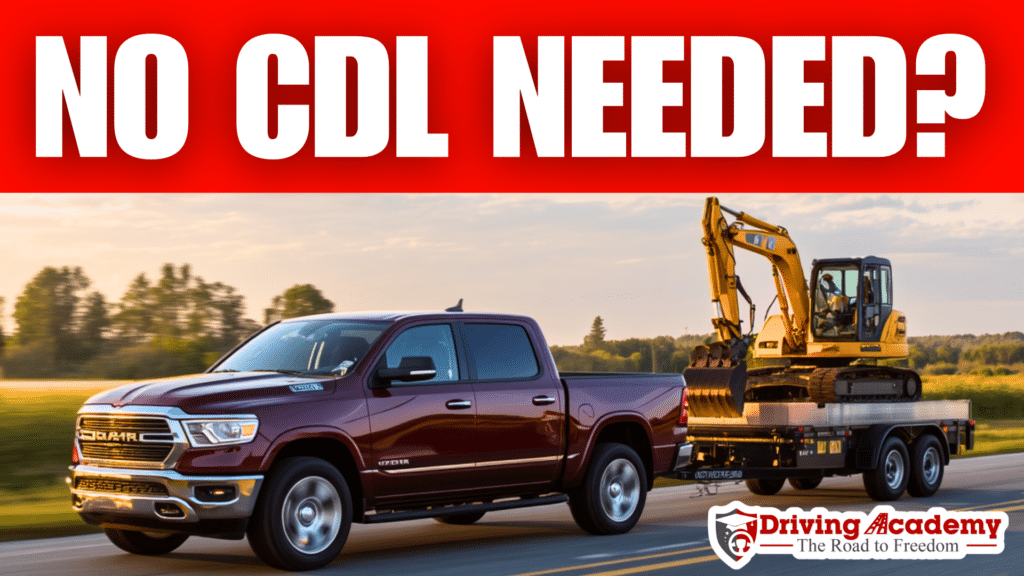
Hey future trucker! Today, we’re gonna dive deep into a topic that has the whole industry talking: hot shot trucking.
This is a “hot” topic for a lot of people (pun intended!), but there’s also a lot of mystery surrounding it. Most people don’t fully know what they’re getting themselves into before they actually get started. So, in this guide, we are going to talk about exactly what hot shot trucking is, what the rules are, what kind of freight you can haul, and answer the ultimate question: Do you need a CDL license for one?
Let’s get rolling!
What is Hot Shot Trucking?
At its core, hot shot trucking is just the ability to transport things using a pickup truck. Now, you might be thinking, “Well, a pickup truck can’t really be transporting that many things, right?”
Correct! That’s where you attach a trailer to the back of a pickup truck, and you use that to transport things from Point A to Point B.
That is all hot shot trucking is. You aren’t driving a massive 18-wheeler, but you are still moving important freight!
What Kind of Freight Do Hot Shot Truckers Haul?
Because hot shot truckers don’t use massive 53-foot semi-trailers, they specialize in moving smaller, highly time-sensitive loads. Companies use hot shots when they need freight moved fast and can’t wait for a traditional freight hauler to fill up an entire semi-truck.
If you become a hot shot driver, you will typically haul things like:
- Construction materials and machinery needed immediately at a job site.
- Agricultural equipment, like small tractors or farming supplies.
- Time-sensitive manufacturing parts to prevent a factory from shutting down.
- Vehicles, RVs, or boats.
Types of Hot Shot Trailers
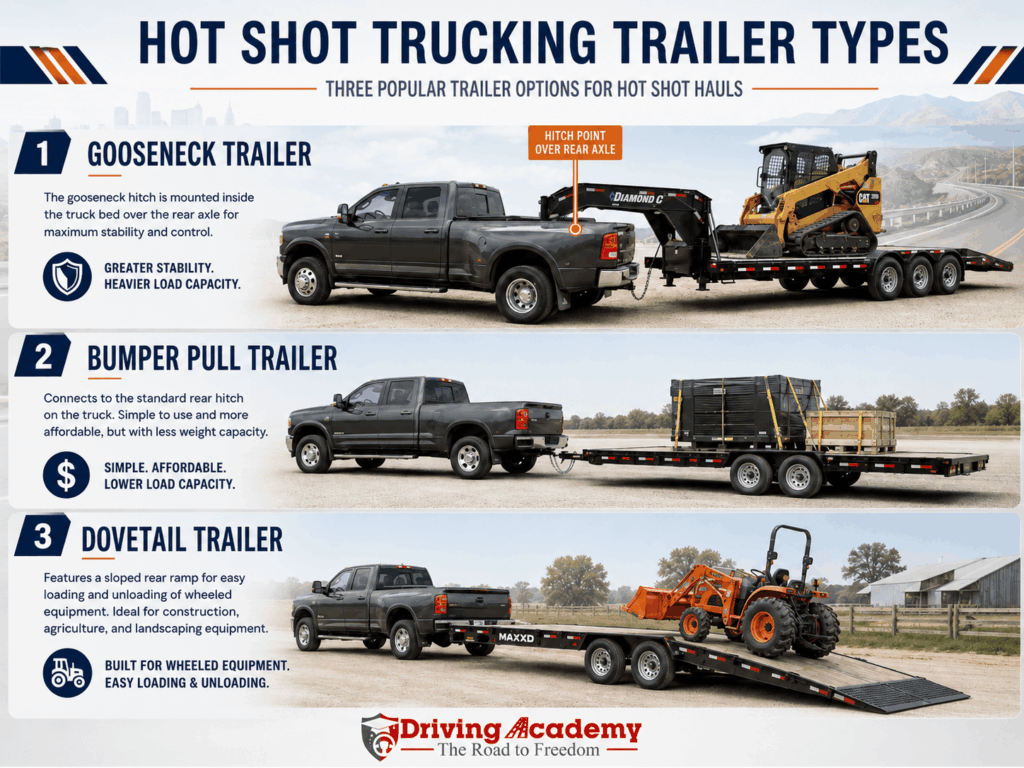
The type of freight you can carry depends heavily on the trailer you attach to your truck. The most common trailers used in the hot shot industry include:
- Gooseneck Trailers: This is the most popular choice for serious hot shotters. Instead of attaching to the back bumper, a gooseneck hitch is mounted directly inside the bed of the pickup truck (over the rear axle). This provides much more stability and allows the truck to pull heavier loads safely.
- Bumper Pull Trailers: These attach to the standard hitch on the back of the truck. They are generally cheaper and easier to use but cannot carry as much weight as a gooseneck.
- Dovetail Trailers: These have a rear ramp that slopes down to the ground, making them perfect for driving wheeled equipment (like cars or small tractors) right up onto the trailer bed.
Hot Shot Rules: Interstate vs. Intrastate
There are different rules when it comes to hot shot trucking depending on where you are driving.
When you’re actually traveling across state lines, you’re going to be dealing with interstate commerce. This means there are going to be certain federal rules that you’re going to have to be aware of such as maintaining your time logs, especially if you are traveling more than a 150-mile radius around your starting destination.
If you’re staying within your own state (intrastate commerce), there are generally fewer rules. You can see how complicated this can actually be right out of the gate!
Do You Need a CDL for Hot Shot Trucking?
One of the biggest things that people don’t understand is how much weight you can carry. When it comes to the weight, the rules are simple but strict. It all comes down to the Gross Combined Weight Rating (GCWR) of your truck and trailer:
- No CDL Required: If the overall vehicle and trailer combined are rated to carry LESS than 26,000 lbs, no CDL is required.
- Class B CDL Required: If the overall vehicle is rated to carry MORE than 26,000 lbs, but the trailer is less than 10,000 lbs, you’re going to need a CDL Class B license.
- Class A CDL Required: If the overall vehicle is rated to carry more than 26,000 lbs AND the trailer is more than 10,000 lbs, you are required to get a CDL Class A license.
The Heavy Trailer Trap ( $5,000 Fine)
This is one of the biggest misunderstandings when it comes to hot shot truck drivers. In many cases, when you add the heavy trailer to the big pickup truck and you put the freight weight on top of it, you’re going to be over 26,000 lbs. This means you are legally required to get a CDL.
Most people get into this field because they don’t want to get a CDL, but they can get in trouble down the road. If you’re caught operating a vehicle that’s over 26,000 lbs without a CDL license, the fine can be $5,000 or higher depending on the state that you’re in. It is super, super important that you don’t get yourself caught up in a situation that’s going to cost you thousands of dollars in the future.
Pros and Cons of Hot Shot Trucking
So now you might be thinking: If I’m going to need a CDL license in most cases anyway, why would I go for a hot shot versus a tractor-trailer?
The Pros
- Lower Startup Costs: You can often buy a pickup truck and a trailer cheaper than a semi-truck.
- No CDL Needed (If you stay small): If you want to start off smaller, are limited on what you can carry, and keep the weight strictly below 26,000 lbs, you don’t need a CDL license. It is one less step.
- Be Your Own Boss: It’s a great way to start a small business.
The Cons
- Limited Capacity: You don’t have that much space to carry things, which means you’re going to be limited on what type of loads you can carry (and how much money you can make).
- Sky-High Maintenance Costs: In many cases, hot shot truckers are using pickup trucks to do things that they were never designed to do. Pulling super heavy things, going uphill, downhill, and wearing out brakes, all of those things add up. Your ongoing maintenance costs will start stacking up not in your favor.
Hot Shot vs. Tractor-Trailer: Which is the Better Investment?
If you want to make more money because you want to transport a higher quantity of things, getting a CDL and driving a tractor-trailer is probably going to be the best option for you.
While the startup costs for a tractor-trailer are going to be a little bit higher, think about it this way: if you take a used tractor-trailer compared to a brand new pickup truck with all the bells and whistles, the prices might be very similar. Furthermore, the used tractor-trailer is built to transport heavy things all day long! The maintenance costs will often be a lot lower than constantly fixing a brand new pickup truck.
FAQs About Hotshot Trucking
It is called hotshot trucking because the loads are usually urgent or important enough to need faster delivery. In many cases, hotshot drivers are hired to move freight that cannot wait for a standard shipping schedule.
Hotshot trucking is usually done with a heavy-duty pickup truck, such as a one-ton truck, paired with the right type of trailer. The exact setup depends on the weight and type of freight being hauled.
The most common trailers used in hotshot trucking are gooseneck trailers, bumper pull trailers, and dovetail trailers. The right trailer depends on the type of cargo, how much weight needs to be carried, and how the freight needs to be loaded.
The biggest difference is the size of the load and the vehicle being used. Hotshot trucking usually handles smaller loads with a pickup and trailer, while regular trucking often uses a semi-truck and full-size trailer for larger freight.
Not always. Whether you need a CDL for hotshot trucking depends on the combined weight rating of the truck and trailer, along with how the equipment is being used. Some hotshot setups are non-CDL, while heavier ones may require a CDL.
Hotshot trucking can be a good option for some beginners, but it still requires planning, safe driving, and a good understanding of equipment and freight. It may look simpler than big-rig trucking, but it still comes with real responsibility.