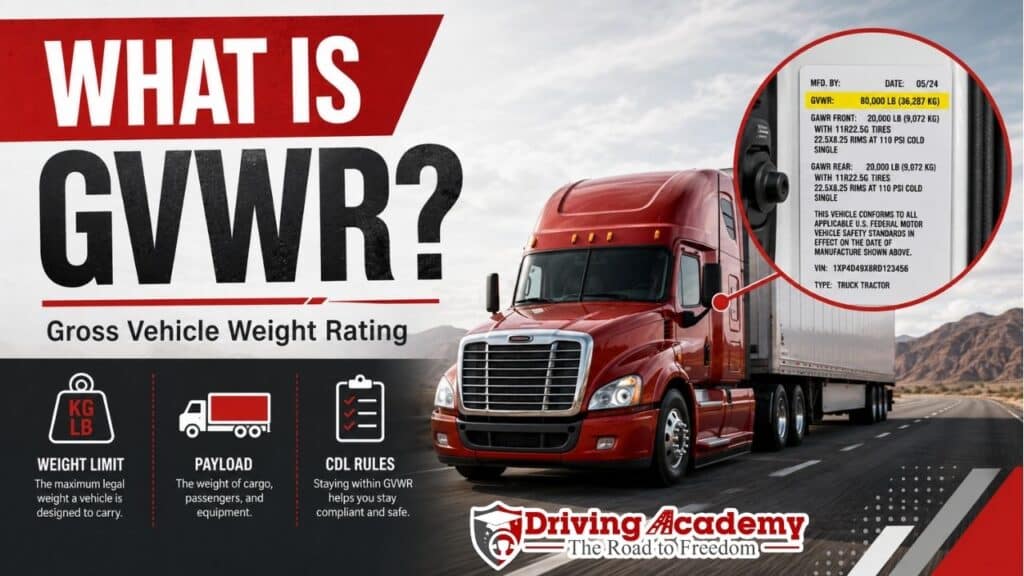
If you are asking what is GVWR, the short answer is this: GVWR stands for Gross Vehicle Weight Rating. It is the maximum loaded weight a vehicle is designed to handle safely, as set by the manufacturer.
For people in the trucking industry, GVWR matters because it affects safety, payload, compliance, and even what class of CDL license you need.
If you don’t understand and follow GVWR, you can overload a truck, reduce braking performance, damage equipment, put yourself at risk for violations or worst case scenario; get in a horrible accident!
In this ultimate guide, we are going to break down the exact trucking definition, the federal weight rules and how to calculate your payload capacity so you can keep your truck safe and strictly legal on the road.
Let’s get rolling!
What Is GVWR?
In the trucking world, the GVWR is the absolute maximum safe operating weight of a commercial vehicle, as determined by the manufacturer. It is the structural limit of what the truck’s frame, suspension, axles, and brakes can safely handle.
Your GVWR includes the combined weight of:
- The empty truck itself
- All engine fluids and a full tank of diesel fuel
- The driver and any passengers
- All of the freight and cargo that could be loaded in the back
It is critical to understand that your GVWR is a weight limit, not the actual weight of the truck as it sits right now.
If a box truck has a GVWR of 33,000 lbs, that means the truck and everything inside of it can’t legally weigh a single pound over 33,000 lbs when you roll over a DOT scale.
Where to Find the GVWR on a Commercial Truck
You don’t have to guess or do any complex math to find your truck’s GVWR. The manufacturer legally has to stamp it on the vehicle.
If you are doing your pre-trip inspection, you can find the GVWR in a few specific spots:
- The Door Jamb Placard: Open the driver’s side door of your cab. There will be a federal certification sticker or metal plate inside the door frame that clearly lists the GVWR, as well as the gross axle weight ratings (GAWR).
- The VIN Plate: On many commercial trucks, the GVWR is stamped onto the main VIN plate located on the dashboard or engine block.
- On the Trailer: If you are pulling a commercial trailer, the trailer has its own separate GVWR! You can usually find the metal placard riveted to the front driver’s side of the trailer frame.
GVWR And The 26,001 lb. CDL Rule
This is the most important section for anyone looking to enter the commercial driving industry. Your truck’s GVWR directly dictates whether or not you legally need a Commercial Driver’s License (CDL) to turn the key.
By federal law, if a vehicle has a GVWR of 26,001 pounds or more, you must have a CDL to operate it.
Here is how the DOT breaks down the classes based on GVWR:
- No CDL Required: The truck has a GVWR of 26,000 lbs or less (like a standard delivery van or a U-Haul).
- Class B CDL: The truck has a GVWR of 26,001 lbs or more, but any trailer it is pulling has a GVWR of less than 10,000 lbs (like a garbage truck, cement mixer or heavy dump truck).
- Class A CDL: The truck has a GVWR of 26,001 lbs or more, AND the trailer it is towing has a GVWR of more than 10,000 lbs (like a standard 18-wheeler semi-truck).
GVWR vs. GCWR (Gross Combined Weight Rating)
If you are going for your Class A CDL to drive tractor-trailers, you are going to see the acronym GCWR on your permit tests. It is easy to get them confused, but the difference is simple:
- GVWR (Gross Vehicle Weight Rating): Applies to a single unit. The truck has its own GVWR, and the trailer has its own separate GVWR.
- GCWR (Gross Combined Weight Rating): This is the maximum allowable weight of the truck and the trailer combined together as one unit. When a fully loaded semi-truck rolls into a weigh station, the scale is measuring the GCWR.
GVWR vs. Curb Weight vs. Tare Weight
Trucking is full of jargon. When dealing with dispatchers and shipping receivers, you need to know the difference between these three weight terms:
- Curb Weight: The weight of the truck exactly as it rolled off the factory floor. It includes a full tank of fuel and all necessary fluids, but zero cargo and zero passengers.
- Tare Weight: What the scale reads when an empty truck rolls over it. It includes the curb weight plus the driver and their gear, but no freight in the back.
- GVWR: The maximum legal limit the truck can weigh when it is fully loaded with freight.
How to Calculate Your Truck's Payload Capacity
As a truck driver, you need to know exactly how much freight you can legally load into your box or trailer without getting an overweight ticket. This available cargo capacity is called your Payload Capacity.
To find out how heavy your freight can be, you use a very simple trucking formula:
GVWR – Curb Weight = Payload Capacity
Example:
Let’s say your commercial box truck has a GVWR of 33,000 lbs. You look at the manufacturer specs, and the Curb Weight (empty truck) is 13,000 lbs.
33,000 lbs – 13,000 lbs = 20,000 lbs.
You can legally load up to 20,000 lbs of freight into the back of your truck.
What Happens If You Exceed Your Truck's GVWR?
You should never let a dispatcher pressure you into loading a truck past its GVWR. If you roll into a DOT weigh station and the scales show you are over your GVWR, the consequences are severe.
- Massive DOT Fines: Overweight tickets are incredibly expensive. You will be hit with massive fines that go on your permanent safety record.
- Placed “Out of Service”: The DOT officer will not let you leave the weigh station. You will be placed out of service until another truck arrives to offload the excess freight.
- Severe Mechanical Danger: Operating over the GVWR is incredibly dangerous. It severely increases your stopping distance, causes commercial tires to blow out under the intense pressure, and can lead to complete air brake failure on steep downhill grades.
FAQ: GVWR in the Trucking Industry
Understanding GVWR is one of the first steps to understanding how truck weight, payload, and CDL rules all connect. Once you know what GVWR means, it becomes much easier to see why weight ratings matter so much in the trucking industry. If you want help turning that knowledge into a real CDL plan, contact Driving Academy to speak with an advisor and find the right training path for your goals.