We all know getting that CDL license in your hand is an incredible feeling. But if you aren’t careful about the specific equipment you use during your state DMV exam, you might look at the front of your CDL license and notice a letter stamped under the “Restrictions” column.
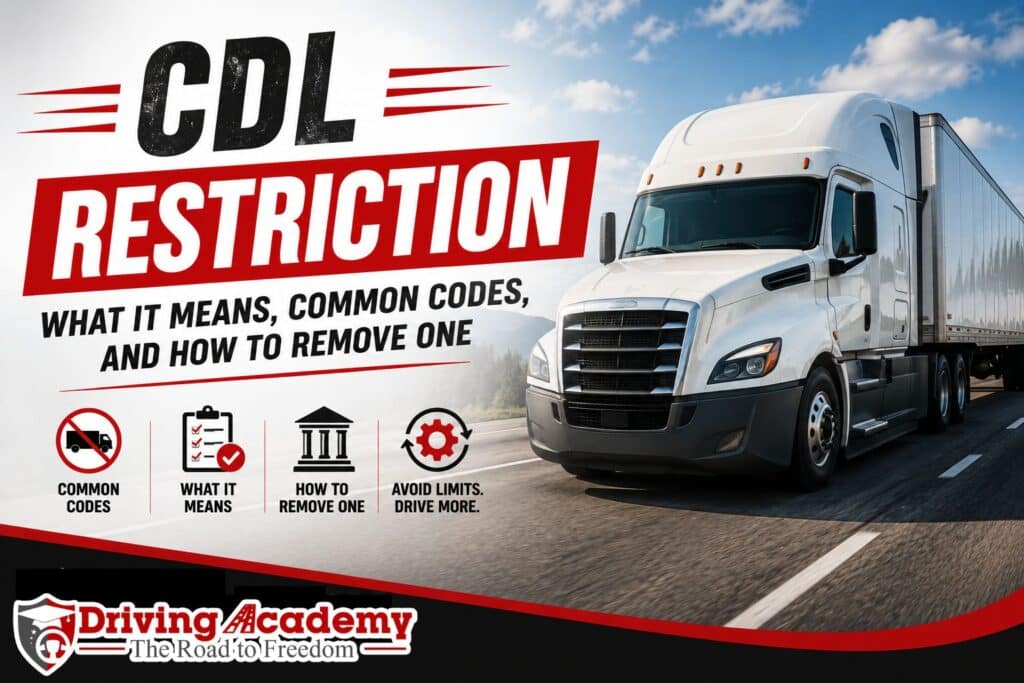
A cdl restriction acts as a legal boundary on your commercial driver’s license. It tells employers and law enforcement exactly what types of commercial motor vehicles you’re prohibited from driving.
If you have a restriction code holding your career back, you’re leaving money on the table. Fortunately, these codes aren’t permanent. Below is a complete guide to understanding every major CDL restriction code, how they affect your job options, and the exact steps to remove them.
Not sure how a restriction code affects your job hunt?
What Is A CDL Restriction?
A CDL restriction is a code placed on your commercial driver’s license that limits what you can legally drive. When you take your 3-part CDL skills test, the state requires you to test in a vehicle that accurately matches the type of truck you plan to operate out in the real world. If your test vehicle lacks critical mechanical systems such as a manual gearbox or full air brakes, the state automatically applies a restrictive code to your license.
In simple terms, endorsements add privileges to your CDL, while restrictions take some privileges away. So you might have the right CDL class, but still be blocked from operating certain vehicles because of a restriction on the license.
CDL Restriction Reference Table
| Code Letter | What It Restricts | How It Was Triggered |
|---|---|---|
| E | Banned from driving manual transmissions | Tested using an automatic truck |
| L | Banned from driving air brake vehicles | Failed air brake exam or tested on hydraulic brakes |
| Z | Banned from full air brake configurations | Tested in an air-over-hydraulic vehicle |
| O | Banned from standard fifth-wheel semi-trucks | Tested with a pintle hook/utility trailer hookup |
| M | Class A holder restricted to Class B/C passenger buses | Took passenger exam in a Class B vehicle |
| N | Class B holder restricted to Class C passenger vehicles | Took passenger exam in a Class C vehicle |
| K | Restricted to driving within your home state only | Driver is under 21 or lacks interstate medical clearance |
| V | Requires an active medical waiver document | Driver has an FMCSA-approved medical exemption |
Let’s look closer at the most common mechanical and operational restrictions that limit a driver’s day-to-day employment options.
1. E Restriction:
Automatic Transmission Only
The E restriction cdl code has become incredibly common because many modern trucking fleets and driving schools have shifted to automatic trucks. If you take your road skills exam in an automatic commercial vehicle, you are legally restricted from driving a manual transmission CMV.
The Career Impact: While automatic trucks dominate long-haul logistics, holding an automatic transmission restriction cdl prevents you from taking higher-paying regional hauling roles, specialized heavy-haul cargo jobs, or working for carriers that maintain classic 10-speed or 13-speed manual fleets.
2. L Restriction:
No Air Brake Equipped
This is the most limiting restriction a driver can receive. The L restriction cdl indicates that you are legally barred from operating any commercial vehicle equipped with air brakes. This restriction is triggered if you fail the air brakes written exam module, miss air brake components during your pre-trip inspection, or take your road test in a truck utilizing standard hydraulic brakes.
The Career Impact: Because virtually every standard Class A semi-truck and large Class B dump truck over 26,000 pounds relies completely on air brakes, a no air brakes restriction reduces your job options to light box trucks or basic hotshot setups.
3. Z Restriction:
No Full Air Brake System
Similar to the “L” code, a Z restriction means you tested in a truck that uses an air-over-hydraulic braking system rather than a dedicated, full-air setup. While you can drive certain light air-assisted platforms, you are banned from operating standard full-air brake tractor-trailers.
4. O Restriction:
No Tractor-Trailer Connection
If you test for a Class A CDL using a truck pulling a trailer with a pintle hook, ball hitch, or utility connection instead of a standard fifth-wheel kingpin setup, you receive an “O” restriction. This prohibits you from driving traditional semi-truck tractor-trailers, limiting you heavily to specialized utility or hotshot configurations.
5. M and N Restrictions:
Passenger Class Limits
These codes apply when you hold a higher-class baseline license but test for passenger permissions in a smaller vehicle class:
- M Restriction: You hold a Class A CDL but took your Passenger (P) or School Bus (S) road test in a Class B vehicle. You are restricted to driving Class B or C passenger buses only.
- N Restriction: You hold a Class B CDL but performed your passenger test elements in a small Class C vehicle. You cannot drive Class A or B passenger vehicles.
6. K Restriction:
Intrastate Only
The K Restriction restricts you from crossing state lines while hauling commercial freight. This restriction gets trigger when the driver is under 21, selected intrastate self-certification category, or lacks interstate medical clearance.
7. V Restriction:
Medical Variance
If you suffer from a physical condition (such as specific visual impairments or diabetes) that requires an official FMCSA regulatory waiver to operate a CMV, a “V” code is stamped on your license. You must carry your formal medical variance paperwork whenever you are on duty. Learn more about getting a CDL with diabetes.
How To Remove A CDL Restriction
The exact process depends on the restriction, but the general rule is simple:
you usually have to pass the required test again in the correct vehicle or under the correct conditions.
For example, to remove an L restriction, the driver must take the air brake written test and complete skills and drive testing in a vehicle equipped with the proper brake system.
No restriction code on your license is permanent. If your career goals change or you lose a job opportunity because of a code limitation, you can follow a strategic plan to remove cdl restriction barriers completely.
If you need help removing a restriction, Driving Academy can assist!
Common Steps Needed To Remove A Restriction:
Step 1: Pinpoint the Correct Training Equipment
To lift an equipment-based restriction, you must retest at the DMV using a vehicle that possesses the missing mechanical features. For an E restriction, you must supply a manual transmission truck. For an O restriction, you must supply a tractor-trailer with a standard fifth-wheel coupling.
Step 2: Get The Training Needed
because you still have to pass a physical DMV road test using a specialized truck configuration, trying to do it without professional practice is incredibly risky. That’s where a premier school like Driving Academy comes in, by providing the equipment and hourly training you need without forcing you into an unnecessary full-length program.
Step 3: Pass the Target DMV Skills Exam Components
You do not have to retake the entire CDL testing from scratch. To lift an equipment-based limitation, you only need to perform the specific exam modules associated with that component. For an automatic-to-manual shift upgrade, you will take a driving exam with an evaluator to demonstrate clean clutch control, downshifting, and double-clutching capabilities.
Step 4: Get your License
Once the state examiner signs off on your proficiency using the correct equipment configuration, the DMV will process your paperwork and print a brand-new, restriction-free commercial driver’s license.

How To Avoid Getting The Wrong CDL Restriction?
The best way to avoid the wrong restriction is to train and test in the same kind of vehicle you actually want to drive for work. If you want to drive a manual truck, do not test in an automatic. If you want full air brake privileges, make sure your testing setup covers that. If you want full Class A capability, do not test in a setup that triggers an O restriction.
This is one reason a good CDL school matters. The right school helps you understand not just how to pass the test, but how to avoid walking away with a license that limits your career. That is why we highly recommend you talk to our free CDL advisor before you start your CDL training!