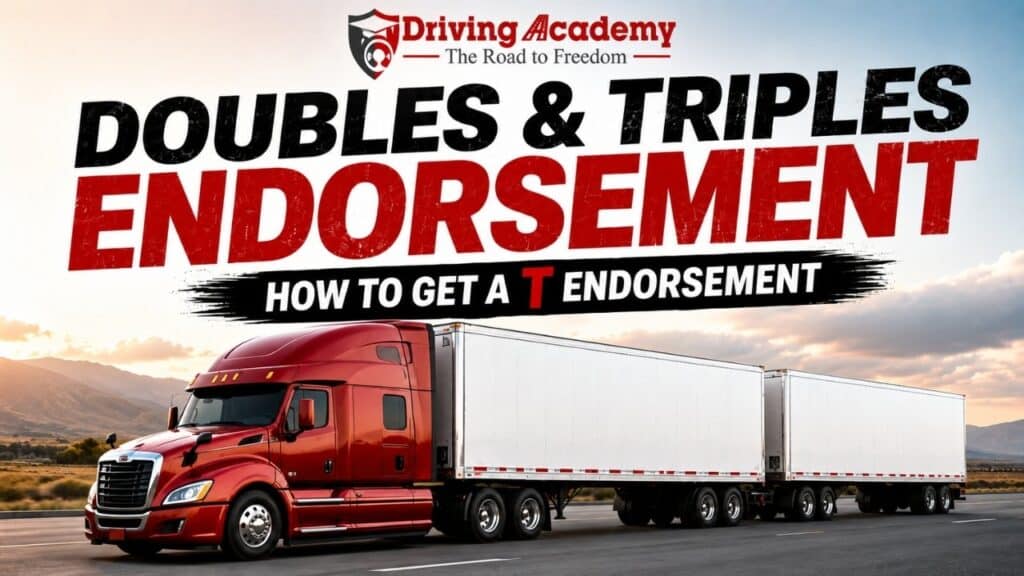
A doubles and triples endorsement, also called a T endorsement, allows a qualified CDL holder to operate commercial vehicles pulling two or three trailers when those combinations are permitted by law.
For most drivers, the main reason to get the endorsement is simple. It can qualify you for more Class A driving opportunities and allow you to operate equipment that a standard CDL alone does not cover.
The endorsement is useful, but it also causes confusion. Many drivers aren’t sure whether they need ELDT, whether a road test is required, or whether triple trailers are legal everywhere. This guide breaks down the process in plain language.
You can also talk to our CDL advisor for free!
What Is a Doubles and Triples Endorsement?
The T endorsement is added to a CDL and gives the driver legal authority to operate qualifying double and triple trailer combinations.
In simple terms, that means a tractor pulling more than one trailer.
- A doubles setup means one tractor pulling two trailers.
- A triples setup means one tractor pulling three trailers.
These combinations are most commonly associated with certain linehaul, LTL, and long-distance freight operations.
Getting the endorsement does not mean every multiple-trailer combination is automatically legal everywhere. State laws, route restrictions, length limits, weight limits, and company policies still matter.
What Does the T Endorsement Allow You to Drive?
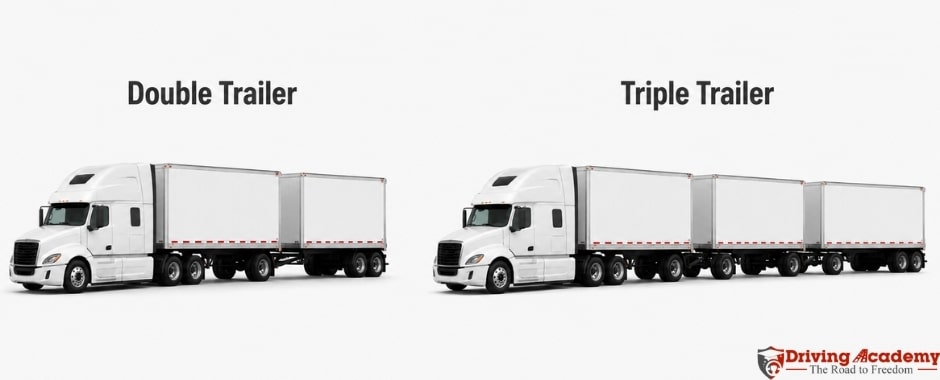
The T endorsement mainly applies to combination vehicles using more than one trailer.
A driver with the proper CDL class and T endorsement may be qualified to operate:
- Double trailer combinations
- Triple trailer combinations where allowed
- Certain linehaul or multiple-trailer freight setups
This endorsement doesn’t replace the underlying CDL class. It adds operating authority for specific trailer combinations.
This is an important distinction. A driver still needs the right CDL for the vehicle itself. Learn more about the difference between Class A and Class B CDL.
What Is a Converter Dolly?
A converter dolly is a small trailer-like unit with one or more axles and a fifth wheel. It allows another semi-trailer to be connected behind the first trailer in a double or triple combination.
In a typical double-trailer setup, the tractor pulls the first trailer normally. A converter dolly connects the first trailer to the second trailer.
Drivers preparing for the doubles and triples endorsement test should understand how to inspect and safely connect a converter dolly. The test may cover areas such as the dolly’s fifth wheel, air lines, electrical connections, safety chains, pintle hook, and proper coupling procedures.
Why Should You Get a Doubles and Triples (T) Endorsement?
The biggest reason to get a T endorsement is the chance to qualify for more specialized driving positions and potentially earn more money.
Many linehaul, less-than-truckload, shuttle, and multi-trailer operations require drivers to hold a doubles and triples endorsement.
The endorsement doesn’t guarantee a raise, but it can give you access to a larger group of employers and routes. That matters because truck driver pay often depends on the type of freight, route, experience, employer, and qualifications the position requires. The median wage for heavy and tractor-trailer truck drivers is over $82,000, but specialized positions and experienced drivers may earn more.
A T endorsement can help you:
- Qualify for linehaul and multi-trailer positions
- Apply for jobs that require doubles or triples
- Add another useful qualification to your Class A CDL
- Compete for routes with mileage, drop-and-hook, or doubles-related pay
- Avoid being rejected from a job because your CDL is missing the required endorsement
Getting the endorsement is especially worth considering when employers near you regularly use double trailers. It’s a relatively small addition to your CDL that could increase the number of jobs you can apply for throughout your career.
Contact us and learn more:
How to Get a Doubles and Triples Endorsement
The exact testing process varies by state, but most drivers will follow these steps.
Step 1: Check Your State’s Requirements
- Testing locations
- Appointment requirements
- Identification documents
- Fees
- License reissue procedures
- State-specific testing rules
Step 2: Hold or Obtain the Proper CDL
Step 3: Study the Doubles and Triples Section
Step 4: Take the Doubles and Triples Knowledge Test
Step 5: Have the T Endorsement Added to Your CDL
Passing a knowledge test proves that you understand the written material.
It doesn’t prove that you’ve safely connected, inspected, backed, or driven a multiple-trailer combination.
Ready to bridge the gap between passing the test and mastering the truck?
At Driving Academy, our hands-on training programs put you directly behind the wheel with expert instructors, state-of-the-art equipment, and flexible schedules. Don’t just learn the theory, get the real-world driving experience you need to launch a successful career.
What Is on the Doubles and Triples Endorsement Test?
The test is designed to make sure you understand how multiple trailers behave and what needs to be inspected before driving.
Coupling and Uncoupling
You’ll need to understand the proper order for connecting the trailers and converter dollies.
That includes checking the pintle hook, safety devices, fifth wheel, air lines, electrical connections, and locking mechanisms.
Connection order matters. A trailer that’s connected incorrectly can separate or lose braking and lighting functions.
Inspecting Double and Triple Trailers
Multiple trailers create additional inspection points.
You’ll need to check the tractor, each trailer, the converter dolly, tires, wheels, lights, air lines, coupling devices, and cargo securement.
The rear trailers shouldn’t be treated as an afterthought. Every connection and braking component needs to be safe before the vehicle moves.
Preventing Rollovers
The rear trailer in a multiple-trailer combination is more vulnerable to rollover.
A sudden steering movement at the tractor can become more severe as it travels through each trailer. That’s why speed control and smooth steering are critical.
Drivers should slow down before curves and avoid sudden lane changes.
Braking and Following Distance
A longer combination needs more space to stop safely.
Drivers need to understand brake lag, air brake operation, following distance, and how road conditions affect stopping.
Hard braking can also cause the trailers to lose stability.
Off-Tracking and Turns
Off-tracking happens when the rear wheels follow a path inside the path taken by the tractor.
With multiple trailers, the final trailer may track differently than the tractor and first trailer.
Drivers need extra room during turns and must watch curbs, vehicles, signs, and pedestrians.
Handling Emergencies
The test may ask what to do when:
- A trailer begins to sway
- Braking performance changes
- A connection appears damaged
- Roads become slippery
- The combination begins to lose control
Many questions come down to the same principle: slow down, avoid sudden movements, and never continue with unsafe equipment.
T Endorsement vs. Other CDL Endorsements
| Endorsement | What it covers | Federal test type |
|---|---|---|
| Doubles and Triples (T) | Multiple trailers | Knowledge |
| Hazardous Materials (H) | Placarded Hazardous Materials | Knowledge |
| Tank Vehicle (N) | Qualifying tank vehicles | Knowledge |
| Passenger (P) | Passenger vehicles | Knowledge and skills |
| School bus (S) | School buses | Knowledge and skills |
The T endorsement is only one way to expand your CDL. A Tank Vehicle endorsement may qualify you to operate commercial vehicles carrying qualifying liquids or gases, while a HazMat endorsement is required to transport hazardous materials that need placards. Drivers interested in buses or other passenger transportation can learn more about getting a Passenger endorsement. School bus drivers generally need both passenger and school bus qualifications.
The right endorsement depends on the equipment, cargo, and type of work you want. Review our complete guide to CDL endorsements to compare your options before deciding which tests to take.