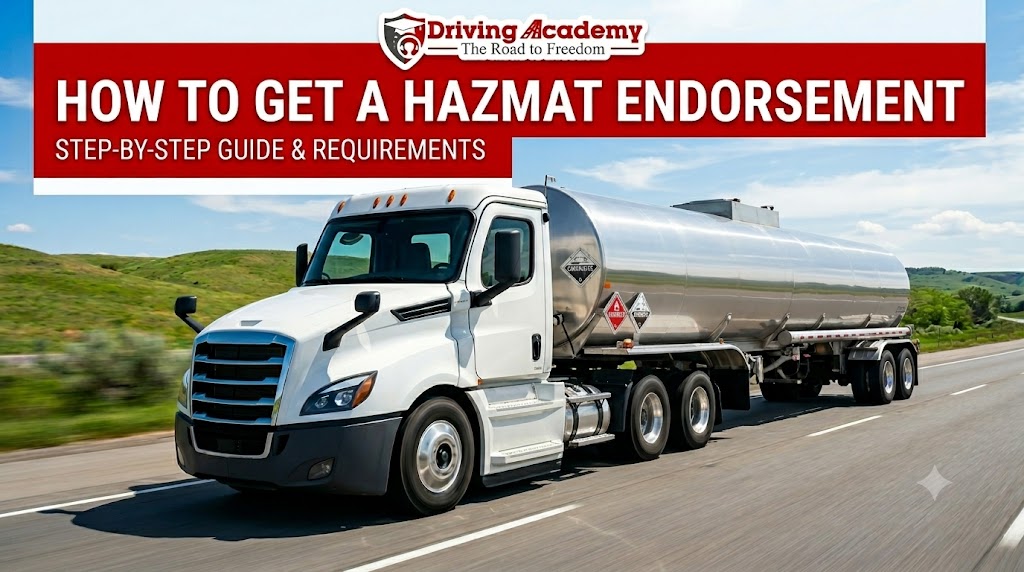
Getting a Hazmat endorsement can open the door to better trucking jobs, but you do have to do it the right way.
This driver’s license add-on allowing you to transport hazardous material isn’t only about passing a test. You also have to complete the required training and clear the TSA background process before the endorsement can be added to your CDL.
That may sound like a hassle, but it is actually pretty simple once you know the drill.
In this article, we will walk you through exactly how to get your Hazmat endorsement.
You could also learn about the process directly from our CDL Advisor!
What a Hazmat Endorsement Actually Does?
A Hazmat endorsement lets a CDL driver haul hazardous materials in situations where federal rules require placarding. In CDL language, this is the H endorsement. FMCSA lists the hazardous materials endorsement as one of the first-time endorsement categories that triggers ELDT requirements.
A lot of drivers also end up looking at the X endorsement, which combines tanker and Hazmat. That usually comes up for drivers who want to haul fuel or other hazardous liquids.
What Materials Count as Hazmat?
Not every dangerous-looking substance requires a Hazmat endorsement. The federal government has a specific definition, and it comes down to whether the cargo requires placarding under DOT regulations.
If the material is listed in the DOT’s Hazardous Materials Table (49 CFR 172.101) and the quantity being transported meets the threshold for placarding, you need the H endorsement to haul it legally.
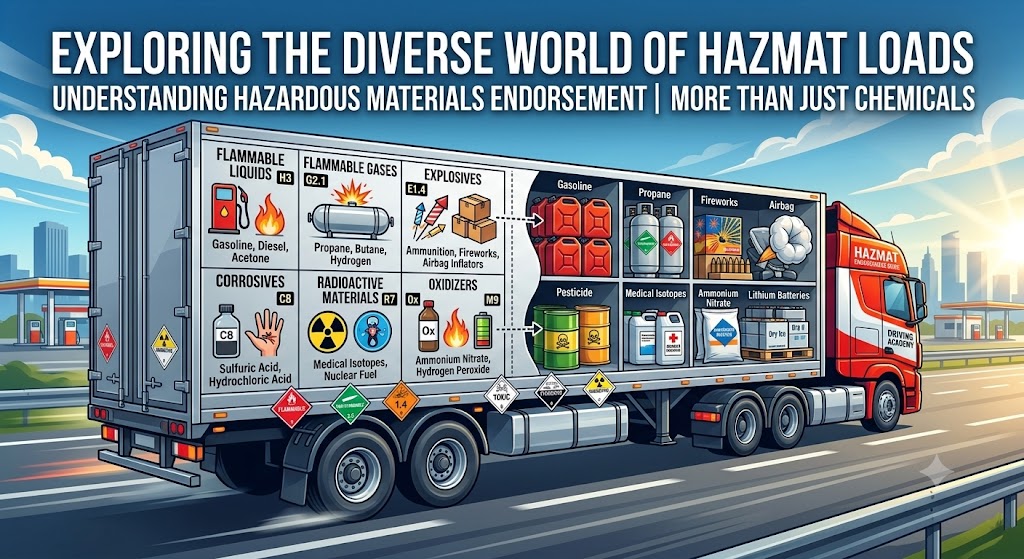
Here are the main categories with common examples:
- Flammable Liquids
Things like gasoline, diesel fuel, ethanol, and acetone. This is one of the most common hazmat loads truck drivers encounter, especially fuel tanker routes. - Flammable Gases
Propane, butane, and hydrogen. These are typically hauled in pressurized cylinders or tank trailers and require careful handling due to explosion risk. - Explosives
Ammunition, fireworks, blasting caps, and airbag inflators. Yes, airbag inflators are something a lot of drivers don’t realize falls under this category. - Toxic or Poisonous Materials
Pesticides, certain industrial chemicals, and chlorine. These require strict containment and emergency protocols in the event of a spill. - Corrosives
Sulfuric acid, hydrochloric acid, and battery acid. These can cause serious damage to skin, equipment, and the road surface if a leak occurs. - Radioactive Materials
Medical isotopes, nuclear fuel, and certain laboratory materials. This category requires the most careful handling and is tightly regulated by both DOT and the NRC. - Oxidizers
Hydrogen peroxide (in high concentrations) and ammonium nitrate. These don’t burn on their own but can intensify fires significantly when combined with other materials. - Miscellaneous Hazardous Materials
Dry ice, lithium batteries (in large quantities), and magnetized materials. Lithium batteries in particular are a growing category as e-commerce and EV shipments increase.
The key takeaway: it is not just chemicals in drums. Hazmat loads show up across all kinds of freight: fuel, agriculture, construction, and even consumer goods. If your load requires a placard on the trailer, you need the endorsement.
How Much More Can You Earn With a Hazmat Endorsement?
Adding a Hazmat endorsement to your CDL makes you eligible for a category of loads that most drivers simply cannot touch. That scarcity works in your favor.
The Numbers
Drivers with a Hazmat endorsement can qualify for some of the highest paying trucking job.
According to industry data, the average CDL-A driver earns around $78,000 per year. Drivers with Hazmat (especially combined with a tanker endorsement as the X endorsement) commonly earn $88,000 or more annually, with some specialized roles pushing past $100,000.
Why the Pay Is Higher?
It comes down to three things:
- Liability: carriers pay more because the stakes are higher. A Hazmat spill creates legal, environmental, and financial exposure that a regular freight load does not.
- Compliance: Hazmat loads require more paperwork, stricter routing, and tighter safety protocols. Drivers who know the rules are worth more.
- Fewer qualified drivers: the TSA background check and ELDT requirement filters out a portion of applicants, so the supply of Hazmat-certified drivers is naturally smaller.
Jobs That Pay a Premium for Hazmat
- Fuel tanker driver (petroleum hauling)
- Chemical transport driver
- Industrial gas delivery
- Agricultural chemical hauling (fertilizers, pesticides)
- Government or military contractor freight
The Hazmat endorsement’s return on investment, measured over even a single year of driving, is significant. For most CDL drivers serious about increasing their earning potential, it is one of the best endorsements worth adding.
Want To Learn More About Hazmat Endorsement?
Steps To Get A Hazmat Endorsement
Step 1: Make Sure Your CDL Situation Is Straight
Before you worry about Hazmat, make sure your CDL plan makes sense for the type of truck you want to drive. The Hazmat endorsement is not a separate license by itself. It gets added onto a CDL. So the endorsement does not replace your Class A or Class B. It sits on top of it.
That means:
- Class A CDL with Hazmat can lead to many tractor-trailer Hazmat jobs
Class B CDL with Hazmat can apply to some straight-truck Hazmat jobs
The truck class depends on the vehicle. The Hazmat endorsement depends on the cargo.
Step 2: Complete Hazmat ELDT Training
Before 2022, you could just walk into the DMV, take a test, and get your endorsement. That is no longer the case.
By federal law, you must complete an approved Entry-Level Driver Training (ELDT) theory course specific to hazardous materials before you are allowed to take the written test at the DMV.
This training covers critical safety protocols, including how to read placards, how to properly load and segregate dangerous chemicals, and what to do in a roadside emergency. You must ensure the school you use is listed on the FMCSA Training Provider Registry (TPR). If they aren’t on the list, your training won’t count.
Step 3: Apply for the TSA Background Check
After training, you still have another major step: TSA. TSA runs the Hazardous Materials Endorsement Threat Assessment Program for drivers who want to obtain, renew, or transfer a Hazmat endorsement.
This is what makes Hazmat different from many other CDL endorsements. You are not only proving knowledge. You are also going through a security screening. TSA reviews identity and checks for certain disqualifying offenses and other factors.
A lot of drivers are not worried about the written test. They are worried about the background side of Hazmat. That is fair. TSA has an official list of disqualifying offenses and other factors, and some of them can block an applicant either temporarily or permanently depending on the situation.
Step 4: Take the Hazmat Test
Once you have completed your ELDT training, you must pass a written knowledge test at your state’s DMV. The test is usually 30 multiple-choice questions, and you must score at least an 80% (24 correct answers) to pass.
Important Note on Order of Operations: Depending on the state you live in, the order of Steps might flip. Some states require you to pass the TSA background check before they let you take the DMV test. Other states make you pass the written test before you can apply for TSA clearance.
Step 5: Finish the State License Process
Once the DMV receives your passing test score and the official clearance from the TSA, they will issue you a new CDL with the “H” endorsement printed right on it. You are now officially certified to haul hazardous materials!
How Long Does It Take to Get a Hazmat Endorsement?
The training and the testing are the fast parts. The waiting is what takes time.
- ELDT Training: Can usually be completed online in a few hours.
- TSA Background Check: This is the bottleneck. The TSA states it can take anywhere from 30 to 60 days to process your background check and clear your fingerprints.
Overall, expect the entire process to take roughly 6 to 10 weeks from start to finish.