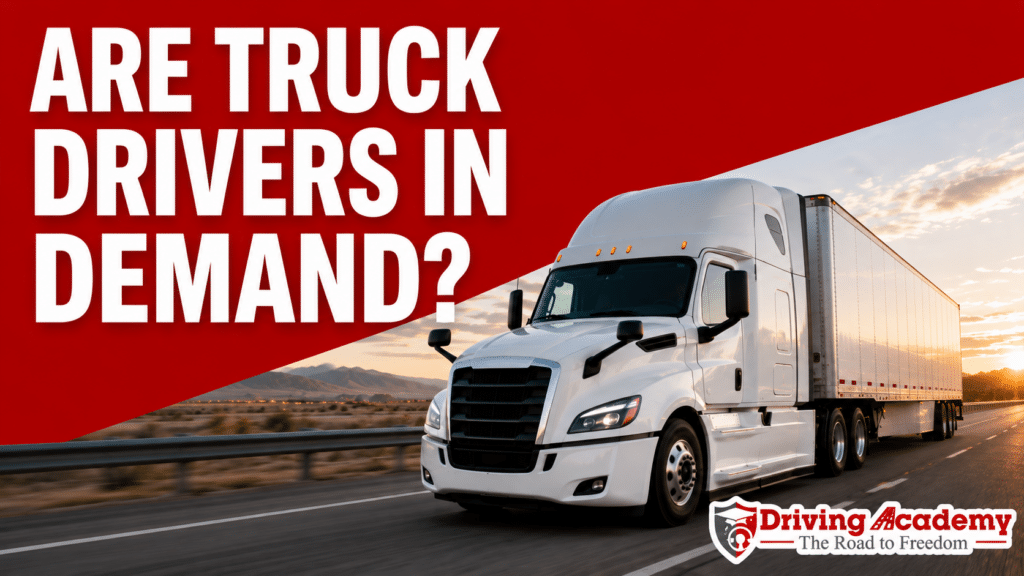
Yes, truck drivers are still in demand. The U.S. Bureau of Labor Statistics projects approximately 237,600 openings for heavy and tractor-trailer truck drivers every year between 2024 and 2034.
Those openings will come from a combination of industry growth, drivers retiring, workers changing careers, and trucking companies replacing drivers who leave their positions. However, demand is not identical in every city, at every carrier, or for every type of driving job.
If you are considering getting a Commercial Driver’s License,
feel free to reach out to our CDL advisor to learn more:
Truck Driver Demand at a Glance
| Employment Statistic | Latest BLS Figure |
|---|---|
| Heavy and tractor-trailer truck driver jobs in 2024 | 2,235,100 |
| Projected employment growth from 2024 to 2034 | 4% |
| Projected new jobs by 2034 | 89,300 |
| Average projected job openings per year | 237,600 |
The projected 4% employment growth rate is slightly higher than the 3% average for all occupations.
The number of annual job openings is much larger than the number of newly created positions. Employers don’t only hire drivers for new jobs. They also need replacements when current drivers retire, switch careers, or leave the workforce.
That replacement demand creates opportunities even when the total number of trucking jobs grows at a moderate rate.
Why Are Truck Drivers in Demand?
Truck driver demand comes from several factors, including freight movement, driver retirement, employee turnover, and the difficulty some carriers face when hiring qualified drivers.
Businesses Depend on Trucks
Trucks move most of the products people and businesses use every day.
Commercial drivers transport:
- Food and beverages
- Construction materials
- Retail products
- Medical supplies
- Fuel
- Machinery
- Automotive parts
- Manufacturing materials
- Household goods
- E-commerce orders
Warehouses, stores, factories, ports, construction sites, farms, and distribution centers all depend on commercial transportation.
Freight volume can rise and fall with the economy, but products still need to move from one location to another. That creates an ongoing need for drivers who can operate commercial vehicles safely and reliably.
Employers Need to Replace Drivers
The trucking industry employs more than two million heavy and tractor-trailer truck drivers.
Many current drivers will retire or leave the occupation during the next decade. Others will move into dispatch, safety, training, management, or different industries.
The Bureau of Labor Statistics expects employers to fill hundreds of thousands of openings each year, even though not every opening represents a brand-new position.
Driver Turnover Remains a Challenge
Some trucking companies regularly lose drivers and need to hire replacements.
Turnover is especially common in long-haul trucking, where drivers may spend days or weeks away from home. Irregular schedules, long workdays, time away from family, and demanding working conditions can make retention difficult.
Companies with high turnover may advertise frequently and hire larger numbers of entry-level drivers.
That doesn’t mean every trucking job is easy to get. Local routes, predictable schedules, and jobs with strong benefits may attract more applicants and can be more competitive.
Experienced Drivers Are Valuable
Trucking companies don’t only need people who hold a CDL. They need safe and dependable drivers.
Employers may give preference to drivers who have:
- A clean driving record
- Documented commercial driving experience
- The right CDL class
- Few or no license restrictions
- Relevant endorsements
- A current medical certification
- A strong safety history
- Experience with specific equipment
- Experience transporting specialized freight
New drivers can still find entry-level opportunities, but experienced drivers usually have access to a wider range of routes, employers, and schedules.
Is There Really a Truck Driver Shortage?
The answer depends on how the word “shortage” is being used.
Some trucking organizations report a national driver shortage, particularly in the long-haul and for-hire trucking sectors.
Other industry groups argue that the main problem is driver retention. They point out that many people already hold CDLs but leave trucking because of pay structures, schedules, working conditions, or time away from home.
Both sides describe real parts of the labor market.
The trucking industry faces a combination of:
- High demand for qualified drivers
- High turnover at certain carriers
- Retirements among older drivers
- Difficulty filling some long-haul positions
- Competition for experienced drivers
- Regional differences in freight demand
- More competition for desirable local routes
There may be a shortage of drivers willing to accept certain jobs, even when a large number of CDL holders exist nationwide.
For someone entering the industry, the most important fact is that companies continue to hire. The quality and availability of those jobs will depend on location, qualifications, experience, and schedule preferences.
What Types of Truck Drivers Are in Demand?
Truck driving isn’t one single job. Drivers work with different vehicles, cargo, schedules, and route structures.
Class A CDL Drivers
A Class A CDL generally provides access to the widest selection of commercial driving jobs.
Class A drivers may operate:
- Tractor-trailers
- Flatbed trucks
- Tanker vehicles
- Livestock carriers
- Car carriers
- Refrigerated trucks
- Double or triple trailers
- Other combination vehicles
A Class A CDL can support local, regional, dedicated, and over-the-road careers.
Some jobs require additional endorsements, experience, or specialized training.
Class B CDL Drivers
Class B CDL drivers can operate many large single vehicles.
Common Class B vehicles include:
- Straight trucks
- Box trucks
- Dump trucks
- Cement mixers
- Garbage trucks
- Delivery trucks
- Certain buses
- Utility vehicles
Class B drivers may work for construction companies, municipalities, delivery services, waste management companies, transit providers, and local businesses.
How Much Do Truck Drivers Make?
The median annual wage for heavy and tractor-trailer truck drivers is around $84,133, according to Indeed.
Truck driver salaries in New Jersey for example can range anywhere from $54,000 all the way up to $210,000 according to job listings on Indeed.
These figures are wage statistics, not guaranteed starting salaries.
Actual truck driver pay can vary based on:
- Location
- Experience
- Employer
- Route type
- Miles driven
- Type of freight
- Endorsements
- Schedule
- Bonuses
- Safety performance
- Pay structure
- Employee or owner-operator status
Some drivers are paid by the hour. Others are paid by the mile, load, route, or percentage of revenue.
Job advertisements may show the highest possible earnings instead of the amount a typical new driver can expect. Applicants should ask employers how pay is calculated and what current drivers usually earn.
Which States Have the Highest Demand for Truck Drivers?
Truck driver demand is often strongest in states with major ports, interstate highways, manufacturing centers, warehouses, and large population centers.
Driving Academy operates CDL schools across the country, including five locations in New Jersey, a Levittown location in Pennsylvania, and an Akron location in Ohio. These states support large freight networks and employ tens of thousands of heavy and tractor-trailer truck drivers.
New Jersey:
New Jersey’s dense population, major interstate highways, warehouses, and access to the Port of New York and New Jersey create demand for local, regional, and port-related truck drivers.
Driving Academy CDL School Locations In NJ
Louisiana:
Louisiana’s ports, energy industry, chemical plants, and agricultural operations depend heavily on commercial transportation. Baton Rouge also sits near I-10 and I-12, two important Gulf Coast freight routes. Louisiana has 40 ports across the state.
Indiana:
Indiana is known as the “Crossroads of America” because of its central location and transportation network. Manufacturing, distribution centers, and the large amount of freight moving through the state create opportunities for truck drivers.
Ohio:
Ohio’s location between the Midwest and Northeast supports local and regional trucking. Manufacturing, automotive production, warehouses, and major cities such as Cleveland, Columbus, Cincinnati, and Akron all depend on commercial drivers.
Pennsylvania:
Pennsylvania connects several major East Coast and Midwestern markets. Its interstate system, warehouses, ports, rail terminals, and manufacturing industries support steady freight movement throughout the state.
Florida:
Florida’s growing population, construction industry, distribution networks, and 16 publicly owned seaports create demand for drivers transporting food, building materials, fuel, retail products, and port cargo.
Oregon:
Portland is a major freight center with access to ports, I-5, I-84, and West Coast distribution networks. Oregon also relies on truck drivers to support agriculture, forestry, manufacturing, and technology industries.
South Carolina:
Greenville and the surrounding Upstate region sit along the busy I-85 corridor. The area’s manufacturing plants, warehouses, and growing logistics industry create opportunities for local and regional CDL drivers.
These states all have very strong trucking market. Driver demand can change by city, employer, route type, and freight sector, so applicants should review current job listings in their area.
Contact us if you want to learn more about getting a CDL in these States:
How Can You Improve Your Truck Driving Job Options?
A CDL creates access to commercial driving jobs. Your qualifications determine how many of those jobs you can realistically pursue.
Choose the Right CDL Class
A Class A CDL generally provides access to more vehicle types than a Class B CDL.
Class B training may still be the better choice for drivers interested in buses, dump trucks, delivery vehicles, or other large single vehicles.
The right license depends on the type of work you want. Learn more about the difference between Class A and Class B CDL
Add Useful Endorsements
CDL endorsements can qualify drivers to operate specific vehicles or transport specific cargo.
Common endorsements include:
- Hazardous materials
- Tank vehicles
- Passenger vehicles
- School buses
- Double and triple trailers
Some endorsements require additional knowledge tests, background checks, or skills tests.
Avoid Unnecessary CDL Restrictions
Restrictions can limit the types of commercial vehicles a driver may operate.
For example, completing a CDL skills test in an automatic transmission vehicle may result in a restriction that prevents the driver from operating a commercial vehicle with a manual transmission.
Drivers should understand the equipment used during training and how it may affect their license.
Protect Your Driving Record
Commercial drivers are held to strict safety standards.
Serious violations can reduce employment options or lead to CDL disqualification.
Drivers should pay attention to:
- Speeding
- Reckless driving
- Following too closely
- Distracted driving
- Impaired driving
- Railroad crossing violations
- Driving without the proper license
- Drug and alcohol testing requirements
A clean driving record can become more valuable as a driver gains experience. Learn more about getting a CDL with DUI or getting a CDL with felony.
Build Safe Driving Experience
Experience is one of the most common requirements in trucking job listings.
The first CDL job may not offer the perfect route or schedule. It can still provide the experience needed to qualify for better opportunities later.
Will Self-Driving Trucks Replace Truck Drivers?
Automation may change commercial transportation, but current employment projections don’t show truck driving disappearing.
The Bureau of Labor Statistics still projects 4% employment growth for heavy and tractor-trailer truck drivers from 2024 through 2034.
Truck drivers also handle responsibilities beyond steering the vehicle.
Their work can include:
- Inspecting equipment
- Securing cargo
- Communicating with dispatchers
- Completing delivery paperwork
- Managing electronic logs
- Responding to road closures
- Handling unexpected weather
- Checking cargo
- Communicating with customers
- Following safety regulations
Autonomous technology may first affect specific highway routes or controlled freight operations.
Many trucking jobs still involve city driving, loading areas, customer interaction, difficult weather, construction zones, and situations that require human judgment.
Technology will continue changing the job, but qualified drivers are expected to remain necessary throughout the current employment projection period.
How to Become a Truck Driver
The licensing process varies by state, but most new drivers follow these steps.
A Class B CDL applies to many large single vehicles, including straight trucks, dump trucks, and certain buses.
The permit allows the student to practice operating a commercial vehicle under qualified supervision.
Required training must be completed through a provider listed on the Federal Motor Carrier Safety Administration’s Training Provider Registry.
Learn more about how to get a CDL,
or reach out to our CDL advisor who will guide you through the process: