When you start driving a commercial truck, road signs take on a whole new meaning. Knowing which signs apply to your truck is an important part of safe commercial driving. Missing a low-clearance warning could result in a bridge strike, while overlooking a weight restriction could mean having to turn around or facing a citation.
Below are 25 important truck road signs and sign messages you should recognize, whether you’re preparing for your CDL or already driving commercially.
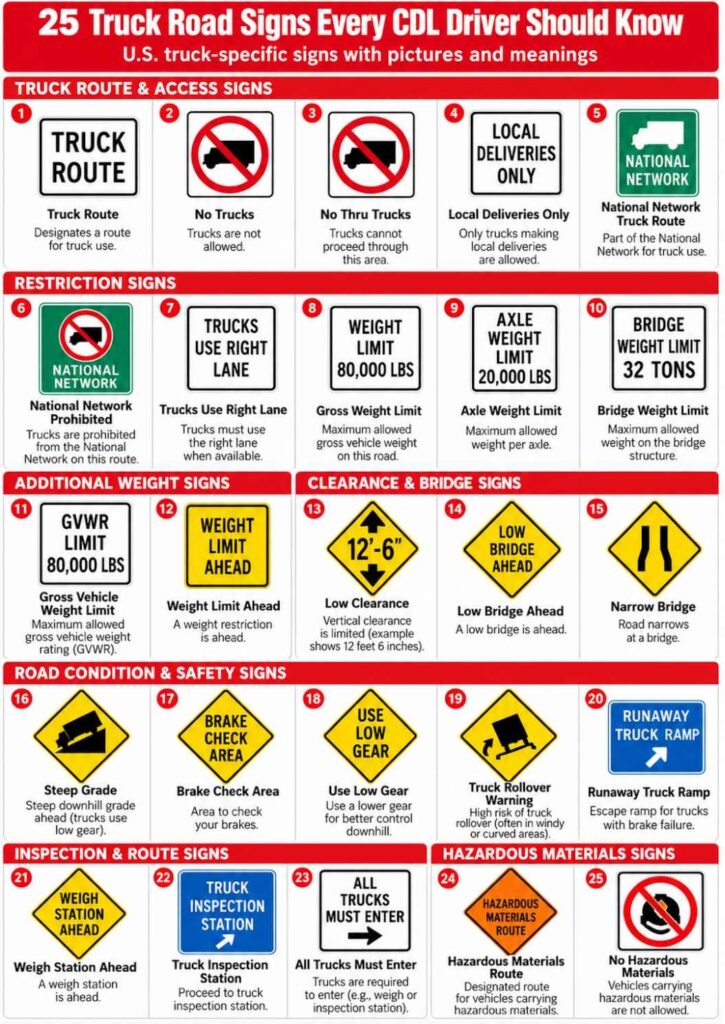
Note: The signs shown are representative examples. Exact sign designs and messages may vary by jurisdiction. Always follow posted signs and applicable laws.
Watch: Important Road Signs for Truck Drivers
Truck Route and Access Signs
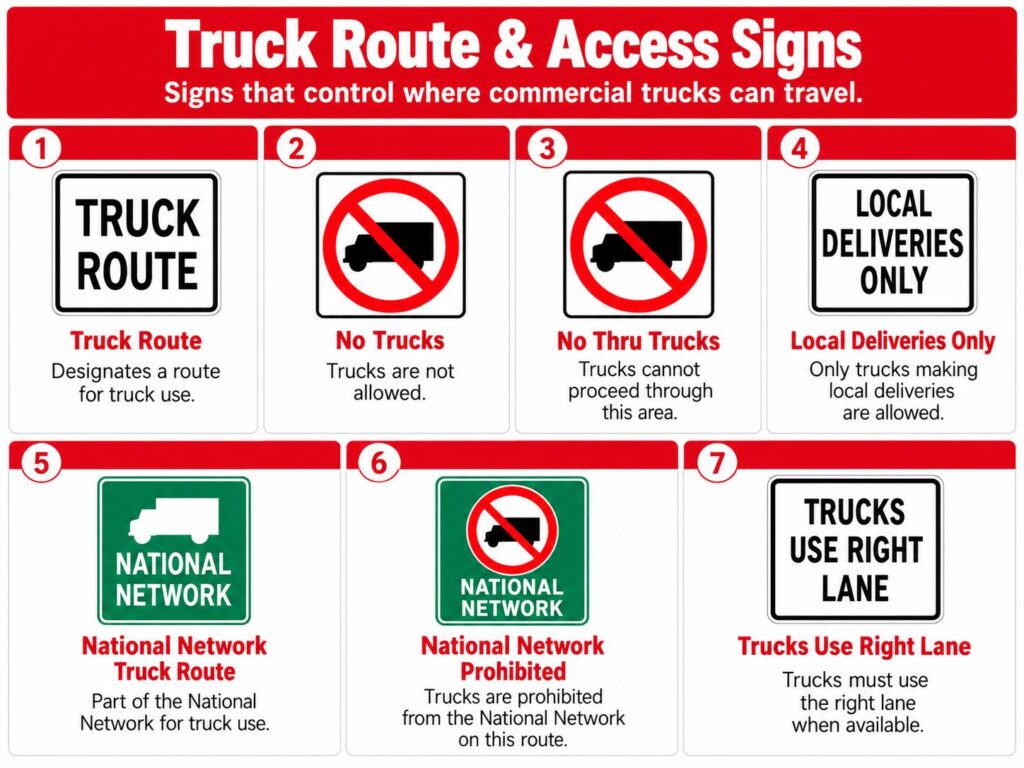
1. Truck Route Sign
A Truck Route sign identifies a roadway designated for truck traffic.
These routes are often selected to accommodate larger commercial vehicles and direct them away from streets where truck access may be limited.
What drivers should know: A Truck Route sign doesn’t automatically mean every truck can use that road. You still need to check for weight, height, length, and other restrictions.
2. No Trucks Sign
A No Trucks sign prohibits truck traffic on the designated road or roadway section.
It commonly displays a truck symbol inside a red circle with a diagonal slash.
What drivers should know: Don’t assume the restriction applies only to tractor-trailers or trucks exceeding 26,000 pounds. Follow the posted restriction and applicable local rules. An exception for deliveries must be authorized, not assumed.
3. No Thru Trucks Sign
A No Thru Trucks sign restricts trucks from using a road as a through route.
These signs are common where authorities want to prevent commercial traffic from cutting through neighborhoods or using local streets to avoid a highway.
What drivers should know: A legitimate local destination may be treated differently under the applicable ordinance, but the exact exception depends on local rules. Drivers shouldn’t assume that every delivery qualifies.
4. Except Local Delivery Sign
An Except Local Delivery plaque may appear beneath a No Trucks sign to identify an exception for qualifying local deliveries.
For example, a driver delivering goods to a business within a restricted area may be permitted to enter, even when through truck traffic is prohibited.
What drivers should know: This is an exception tied to the posted restriction. It does not provide blanket permission to use every truck-restricted street.
5. National Network Truck Route Sign
The National Network is a system of highways designated for certain commercial motor vehicles under federal truck size and route-access rules.
Its official route sign uses a truck symbol inside a green circle.
What drivers should know: National Network designation can help with route planning, but it doesn’t eliminate other posted restrictions, permit requirements, or applicable state laws.
6. National Network Prohibition Sign
This sign identifies a route, segment, or ramp where trucks covered by the restriction are prohibited. It can also be used to mark the end of a designated National Network route.
The official sign uses a truck symbol inside a red prohibition circle.
What drivers should know: Pay attention when leaving a major highway. Not every connecting road is suitable or authorized for your vehicle.
7. Trucks Use Right Lane Sign
A Trucks Use Right Lane sign directs truck traffic into the right lane as specified by the posted instruction.
Truck lane restrictions are common on highways where authorities want to manage heavy vehicles, traffic flow, and passing movements.
What drivers should know: Follow the posted lane requirement, but also pay attention to upcoming exits, lane closures, and other traffic-control instructions.
Truck Weight Limit Signs
Commercial trucks can be much heavier than passenger vehicles, especially when carrying a full load.
Weight restrictions help protect roads, bridges, and other infrastructure. Some signs regulate total vehicle weight, while others establish limits for individual axles or specific vehicle configurations.
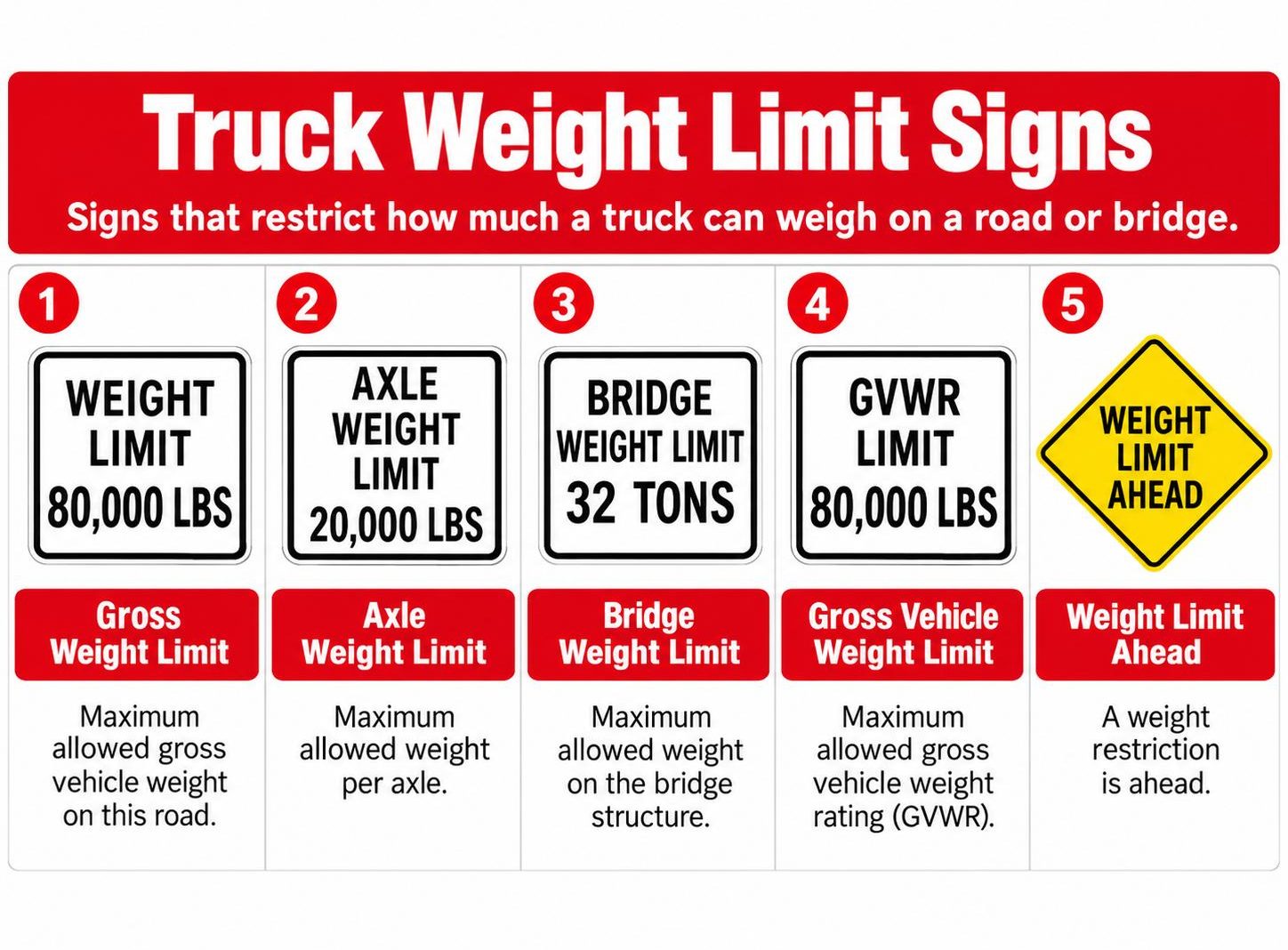
8. Gross Weight Limit Sign
A Weight Limit sign establishes the maximum weight permitted on a particular roadway or structure.
For example, a sign reading “WEIGHT LIMIT 10 TONS” indicates a posted restriction of 10 tons under the applicable rules.
What drivers should know: Your truck’s actual operating weight matters. Don’t confuse the amount of cargo you’re carrying with the total weight of the truck, trailer, fuel, equipment, and load.
9. Axle Weight Limit Sign
An Axle Weight Limit sign restricts the weight carried by an axle or axle arrangement.
A truck can comply with a total gross weight restriction and still exceed an applicable axle-weight limit because of how its load is distributed.
What drivers should know: Correct loading and weight distribution matter just as much as the total amount of freight being transported.
10. Bridge Weight Limit Sign
Bridge weight restrictions identify limits intended to protect a bridge from loads it isn’t rated to support.
The sign may use a general weight limit or specify different limits depending on the vehicle or axle configuration.
What drivers should know: Never assume that a bridge is suitable just because it appears wide enough for your truck. If your vehicle exceeds a posted restriction, use an authorized alternate route.
11. Vehicle-Configuration Weight Limit Sign
Some weight-limit signs show different permitted weights for different types of trucks or axle configurations.
For example, a sign may provide separate limits for smaller straight trucks, tractor-trailers, or vehicles with different numbers of axles.
What drivers should know: Read the entire sign and identify which vehicle configuration applies to you. The maximum permitted weight may differ from that of another truck using the same road.
12. Weight Limit Ahead Warning
Some roadways provide advance notice of a weight restriction farther ahead.
This gives drivers an opportunity to find a legal alternative before reaching a restricted road or bridge.
What drivers should know: Advance warnings are especially useful when planning routes in unfamiliar areas. If you’re approaching a restriction, identify a safe and legal alternative rather than trying to make a last-minute turn.
Truck driver tip: Don’t rely exclusively on a standard passenger-car navigation app. Commercial truck routes need to account for vehicle-specific restrictions. Even truck-focused navigation should be checked against posted road signs.
Truck Height and Size Restriction Signs
Low bridges and narrow roadways can create serious problems for commercial vehicles.
A truck that’s too tall for an overpass can cause a bridge strike, while a road that’s too narrow may leave insufficient room for a large vehicle to pass safely.
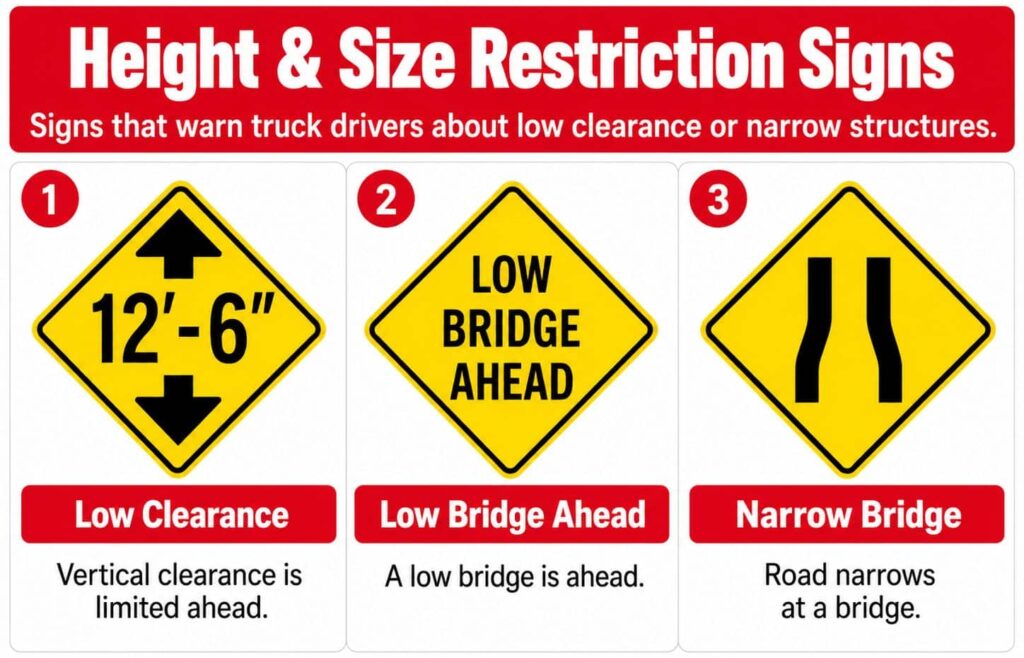
13. Low Clearance Sign
A Low Clearance sign displays the vertical clearance available beneath a bridge, tunnel, overhead structure, or other obstruction.
For example, a sign showing 12 feet 6 inches indicates a posted vertical clearance of 12 feet 6 inches.
What drivers should know: Know your vehicle’s actual height before beginning a trip. If the posted clearance is insufficient, don’t attempt to pass underneath the structure.
Clearance conditions can also change because of road resurfacing, snow, or other circumstances. Never assume an unsigned structure is tall enough for your truck.
14. Low Bridge Ahead Warning
Low-clearance advance warning signs notify drivers that a restricted overhead structure is approaching.
They may display the available clearance and appear before an intersection or other location where a truck can safely take an alternate route.
What drivers should know: Pay attention to these warnings early. The closer you get to a low bridge, the harder it may become to turn around safely.
15. Narrow Bridge Sign
A Narrow Bridge sign warns that the roadway becomes narrower at an upcoming bridge.
Large trucks may have less room for their mirrors, trailers, and other equipment, particularly when another vehicle is approaching from the opposite direction.
What drivers should know: Reduce speed as conditions require, maintain lane control, and evaluate whether your vehicle can safely pass through the restricted area. Additional width restrictions may also be posted.
Steep Grade and Mountain Driving Signs
Driving downhill in a commercial truck is different from driving downhill in a passenger car.
A heavy vehicle carries significant momentum, and relying too heavily on service brakes can cause overheating and reduced braking effectiveness.
These signs help truck drivers prepare for downhill grades, sharp curves, and emergency stopping situations.
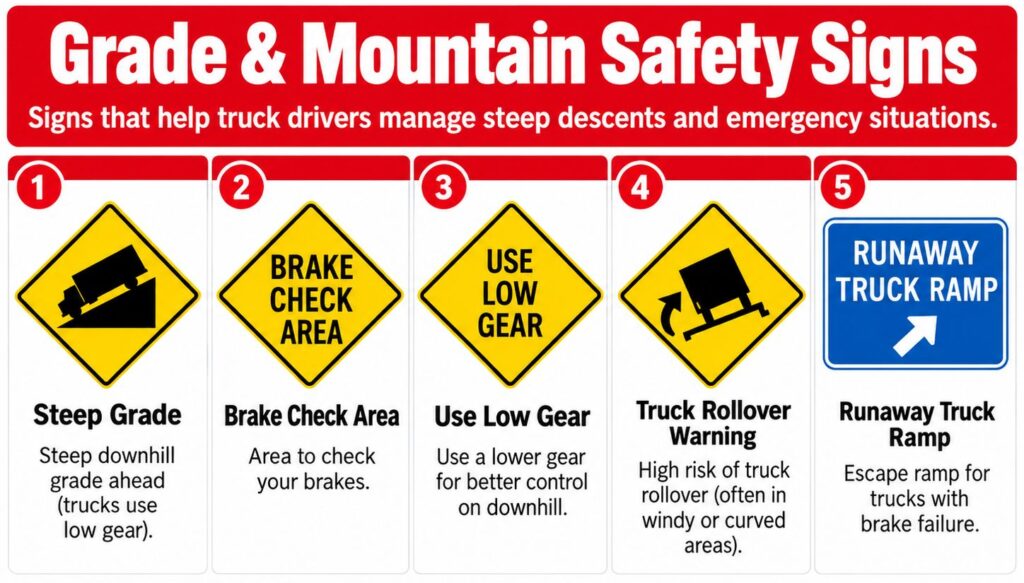
16. Steep Grade Warning Sign
A steep-grade or hill warning sign indicates a significant downhill slope.
Some versions show a truck descending a hill, while others include the grade percentage or distance.
For example, an 8% grade means the road drops approximately eight feet vertically for every 100 feet of horizontal distance.
What drivers should know: Select a safe speed and appropriate gear before starting a steep descent. Don’t wait until the truck is already accelerating downhill to plan how you’ll control its speed.
17. Brake Check Area Sign
Brake Check Area signs identify locations where commercial drivers can stop to inspect their braking systems before continuing.
These areas are especially important near long or steep mountain descents.
What drivers should know: When directed to use a brake check area, follow the posted instructions and applicable requirements. Check your brakes and other critical equipment as appropriate before descending.
18. Use Low Gear Sign
A Use Low Gear or Trucks Use Lower Gear sign advises drivers to select a lower gear for additional vehicle control on a downgrade.
The correct gear depends on your vehicle, transmission, load, road conditions, and the grade.
What drivers should know: Follow your vehicle’s operating procedures and CDL training. A lower gear can help manage downhill speed through engine braking or the appropriate auxiliary braking system.
19. Truck Rollover Warning Sign
Truck Rollover Warning signs alert drivers to curves or other roadway conditions where trucks face an increased rollover risk.
A tractor-trailer has a higher center of gravity than many passenger vehicles, and shifting loads can make the problem worse.
What drivers should know: Reduce speed before entering a sharp curve. Posted advisory speeds, where provided, should be taken seriously, especially when operating a loaded or top-heavy vehicle.
20. Runaway Truck Ramp Sign
Runaway truck ramps, also called truck escape ramps, provide an emergency stopping route for vehicles that cannot safely control their speed on a steep downgrade.
These ramps may use gravel, sand, an uphill slope, or other designs to help stop a vehicle.
Signs may warn drivers that a runaway truck ramp is approaching and identify its entrance.
What drivers should know: These ramps are emergency facilities, not ordinary parking areas. Drivers should learn how to recognize their signs and understand the proper emergency procedures covered in CDL training.
Weigh Station and Inspection Signs
Commercial vehicles may be required to enter weigh stations or inspection facilities to verify compliance with applicable safety and weight requirements.
Not every weigh station operates the same way. Requirements can vary by state, vehicle classification, and posted instructions.
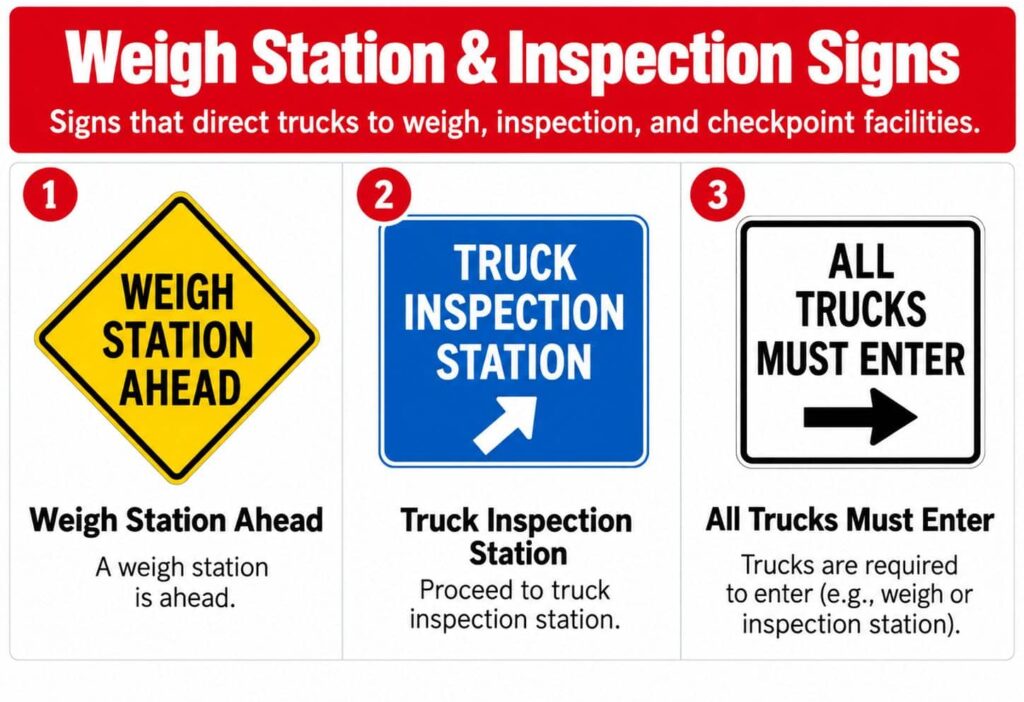
21. Weigh Station Ahead Sign
A Weigh Station Ahead sign informs drivers that a commercial vehicle weighing facility is coming up.
It gives drivers time to prepare for a possible exit or inspection.
What drivers should know: An advance guide sign doesn’t necessarily mean every truck must enter. Follow the applicable weight thresholds, open or closed indications, bypass instructions, and other posted requirements.
22. Trucks Must Enter Weigh Station Sign
A mandatory entry sign directs the vehicles identified on the sign to enter a weigh station.
For example, a sign may require trucks over a specified weight to enter at the next right.
What drivers should know: Check whether the instruction applies to your vehicle. If your truck meets the stated criteria, follow the required entry instructions unless an authorized bypass or other applicable direction permits otherwise.
23. Truck Inspection Station Sign
Truck inspection station signs direct commercial drivers toward facilities used to check vehicles, drivers, or other regulatory requirements.
The exact sign message and presentation can vary by jurisdiction.
What drivers should know: Be prepared to follow posted lane assignments, inspection directions, and instructions from authorized officials.
Hazardous Materials Route Signs
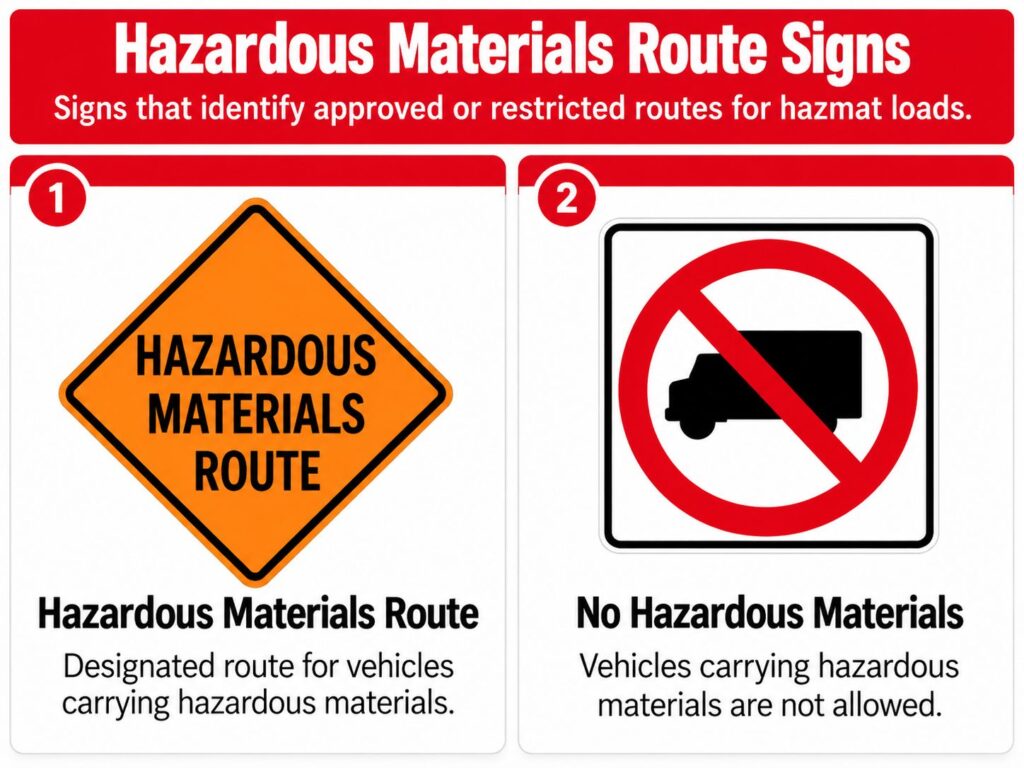
24. Hazardous Material Route Sign
The official Hazardous Material Route sign displays the letters “HM” inside a green circle.
It identifies a route designated by the appropriate authority for transporting hazardous materials.
What drivers should know: A designated HM route is part of route planning, but it doesn’t replace other requirements for transporting hazardous materials, including applicable restrictions, permits, and operating rules.
Drivers pursuing a hazardous materials endorsement can also review our Hazmat CDL practice test resources.
25. Hazardous Material Prohibition Sign
This sign displays the letters “HM” inside a red prohibition circle with a diagonal slash.
It identifies a roadway where transportation of the covered hazardous materials is prohibited under the applicable restrictions.
What drivers should know: Check your authorized route before transporting hazardous materials. Avoid assuming that the same routing rules apply to every type or quantity of hazardous material.
How to Remember Truck Road Signs for Your CDL
Rather than memorizing 25 separate signs without context, group them into a few practical questions.
1. Can my truck use this road?
Look for Truck Route, No Trucks, No Thru Trucks, and other access restrictions.
2. Can my truck safely fit?
Look for low-clearance warnings, narrow bridges, and restrictions involving vehicle dimensions.
3. Is my truck within the weight limit?
Watch for gross weight, axle weight, bridge weight, and vehicle-configuration limits.
4. Do I need to change how I’m driving?
Pay attention to steep grades, lower-gear instructions, rollover warnings, and truck lane restrictions.
5. Am I required to follow a special route or enter a facility?
Look for weigh station instructions, inspection signs, and hazardous-material route restrictions.
Understanding what action each sign requires is more useful than simply recognizing its appearance.

Start by reviewing your state's official CDL manual. Focus on what each sign means and what actions the driver must take.
You can also use Driving Academy's CDL General Knowledge practice test to review commercial driving rules, vehicle safety, and other topics relevant to the CDL permit.
Sources and Further Reading
- Federal Highway Administration: Manual on Uniform Traffic Control Devices
- FHWA: Standard Highway Signs and Markings
- Driving Academy: Official CDL Manuals by State
This article is an educational overview. Sign designs, restrictions, and enforcement requirements can vary by jurisdiction. Always follow posted signs and applicable federal, state, and local requirements.