A non-domiciled CDL allows certain people who are not domiciled in a U.S. state to obtain a Commercial Driver’s License in the United States.
But the rules changed significantly in 2026.
Under the current federal rules, most temporary immigration categories no longer qualify for a non-domiciled Commercial Learner’s Permit or CDL. FMCSA now limits eligibility primarily to people in H-2A, H-2B, or E-2 immigration status.
That means someone who may have qualified under older rules could receive a different answer today.
This guide explains what a non-domiciled CDL is, who qualifies under the 2026 rules, what documents are required, how long the license can remain valid, and what to check before paying for CDL training.
If you are not sure about your situation, you can also reach out to us:
What Is a Non-Domiciled CDL?
A non-domiciled CDL is a Commercial Driver’s License issued to an eligible person who does not meet the normal domicile requirements for a standard CDL in the state issuing the license.
Most CDL drivers receive their license from their home state. FMCSA states that most drivers must obtain a CDL through their home state and cannot hold licenses from more than one state.
A non-domiciled CDL provides an exception for certain applicants who are legally present in the United States but are domiciled somewhere else.
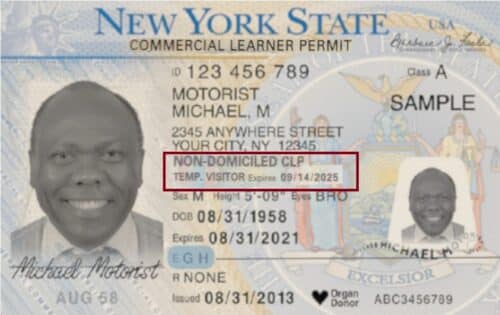
The credential must actually display the words “non-domiciled” on the face of the license. Under the 2026 rule, states can no longer substitute terms such as “limited term” or “temporary” for that designation.
Who Can Get a Non-Domiciled CDL in 2026?
The eligibility rules became much narrower in March 2026.
FMCSA currently limits non-domiciled CLPs and CDLs for foreign-domiciled applicants to people who can provide evidence of lawful immigration status in one of three employment-based
nonimmigrant categories:
| Immigration status | Eligible for a non-domiciled CDL? |
|---|---|
| H-2A Temporary Agricultural Worker | Yes |
| H-2B Temporary Non-Agricultural Worker | Yes |
| E-2 Treaty Investor | Yes |
| DACA | No for a new issuance or renewal under the current rule |
| Asylum/Refugee | No under the current foreign-domiciled eligibility categories |
| Employment Authorization Document only | No |
| Other temporary visa categories | Generally No |
FMCSA states that H-2A, H-2B, and E-2 are the only employment-based nonimmigrant statuses eligible under the current framework. Other immigration categories do not qualify simply because the person is legally allowed to work in the United States.
That distinction is important.
Permission to work in the United States does not automatically mean you qualify for a non-domiciled CDL.
If you are not sure if you qualify, feel free to reach out to Driving Academy:
What Changed With the 2026 Non-Domiciled CDL Rules?
Before 2026, a broader group of legally present noncitizens could potentially receive non-domiciled commercial driving credentials under FMCSA rules and guidance.
The current final rule took effect on March 16, 2026 and significantly narrowed the categories that qualify. FMCSA’s updated guidance now requires eligible foreign-domiciled applicants to show qualifying immigration status in H-2A, H-2B, or E-2.
Several other important changes came with the rule.
EADs Are No Longer Enough
An Employment Authorization Document, commonly called an EAD or work permit, is no longer accepted by itself as evidence that someone qualifies for a non-domiciled CDL.
FMCSA’s 2026 guidance specifically notes that EADs are no longer accepted for this purpose after March 16, 2026.
Immigration Status Must Be Verified
State Driver Licensing Agencies must verify qualifying immigration status through federal records before issuing, renewing, transferring, or upgrading a non-domiciled CDL.
License Validity Is More Limited
A non-domiciled CDL can now be valid for no more than one year, and it may expire sooner depending on the applicant’s authorized stay in the United States.
States Must Be Able to Comply Before Issuing Them
FMCSA says states that cannot comply with the updated rules must pause non-domiciled CLP and CDL issuance until they can meet the federal requirements.
What Documents Do You Need for a Non-Domiciled CDL?
Exact application documents can vary by state, but the federal rules require the state to verify your qualifying immigration status.
For foreign-domiciled applicants, that means your documents must show that you are currently in an eligible category such as:
- H-2A
- H-2B
- E-2
The state also uses federal verification systems to confirm your immigration information.
Depending on the state and your circumstances, you may also need:
- Identity documents
- Your current driver’s license
- Social Security information when applicable
- Immigration documentation
- Proof required by the state licensing agency
- Medical certification when required
- Commercial Learner’s Permit documentation
- Proof of completed ELDT when applicable
Do not assume that having an EAD, immigration receipt, or pending application will satisfy the CDL requirement.
For example, FMCSA says Form I-797C, which is generally a notice or receipt, cannot be used by itself as evidence of qualifying lawful immigration status.
If you are still not sure, feel free to read our Immigrant Eligibility Checklist For CDL article. You can also reach out to our CDL advisor:
How Long Is a Non-Domiciled CDL Valid?
A non-domiciled CDL cannot be valid for more than one year under the current federal rules.
It can also expire sooner.
FMCSA requires the expiration date to be the earliest applicable date among the applicant’s authorized immigration period and the one-year maximum.
For example:
- If your qualifying immigration status expires in six months, your non-domiciled CDL generally cannot be issued for longer than those six months.
- If your immigration documentation is valid for two more years, the CDL still cannot be issued for more than one year.
This is different from a standard CDL, which may follow the state’s normal multi-year licensing period.
Frequently Asked Questions
A work permit or EAD by itself is no longer sufficient under the 2026 federal rules. The applicant must meet the current qualifying immigration-status requirements.
Yes, but the state must verify that you still meet the current eligibility requirements before renewing it.
Learn More About Non-Domiciled CDL
“This article is for informational purposes only and does not constitute legal or immigration advice. CDL eligibility rules and immigration regulations are subject to change. Consult a licensed immigration attorney and your state’s DMV for guidance specific to your situation.”