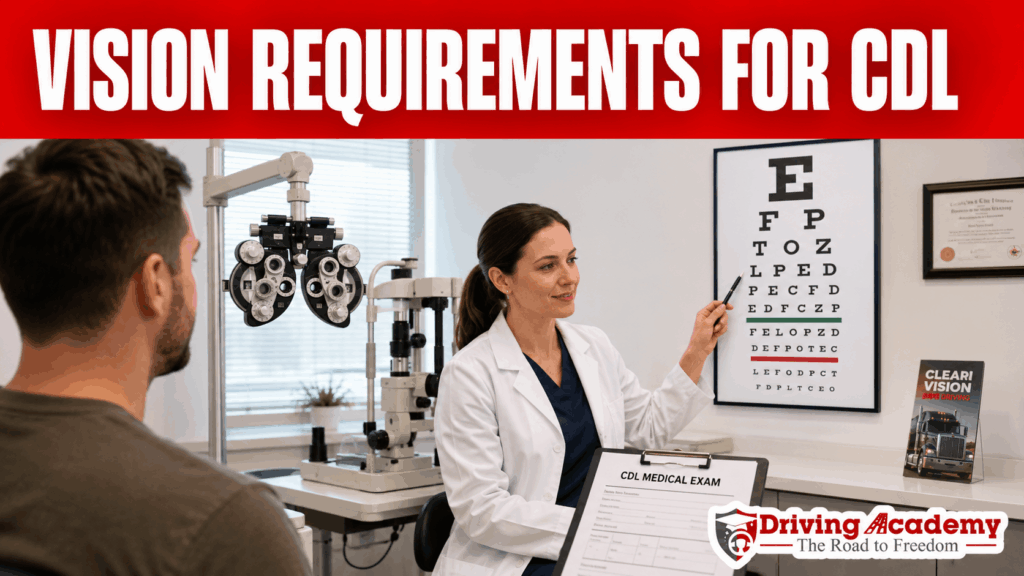
Meeting the FMCSA vision requirements is a mandatory step in earning your CDL and obtaining your DOT medical card. Whether you have 20/20 vision or rely on prescription eyewear, you must demonstrate the ability to see clearly at distance.
The good news?
Most people pass without any issues at all. And even if your vision isn’t perfect, glasses and contacts are totally fine. Let me walk you through exactly what you need to know so there are zero surprises when you sit down for your DOT physical.
CDL Vision Requirements
Here’s everything you need to know about the vision requirements to get a CDL license in one place for your easy reference:
| Requirement | Standard |
|---|---|
| Distance visual acuity | 20/40 in each eye (with or without correction) |
| Both eyes together | 20/40 or better |
| Peripheral vision | At least 70 degrees horizontal in each eye |
| Color recognition | Must distinguish red, green, and amber |
| Corrective lenses allowed | Yes, glasses and standard contacts |
| Monovision contacts | Not permitted |
| Monocular vision | May qualify via MCSA-5871 |
| Medical certificate validity | Up to 24 months |
Not sure if you qualify? Feel free to reach out to our CDL advisor
Why Vision Requirements Matter for CDL Drivers
Before we get into the numbers, let me give you some context on why this matters.
When you’re behind the wheel of a tractor-trailer, you’re operating a vehicle that can weigh up to 80,000 pounds. You need to read road signs at highway speeds, spot hazards ahead of you, monitor your mirrors constantly, and react quickly to everything happening around you. Your eyesight is a fundamental part of doing this job safely.
That’s why the Federal Motor Carrier Safety Administration (FMCSA) sets specific, mandatory vision standards that every commercial driver must meet before they can be certified to drive. These standards are evaluated during the DOT physical exam, which is the medical examination you’re required to pass in order to get your CDL.

What Is the DOT Physical?
The DOT physical which stands for Department of Transportation physical is a medical exam conducted by a certified medical examiner who is registered with the FMCSA. The exam checks your overall health to make sure you’re physically qualified to operate a commercial motor vehicle (CMV).
The vision test is one of the most important parts of this exam. It covers three specific areas:
- Distance visual acuity: how clearly you can see at a distance.
- Peripheral (side) vision: how wide your field of view is.
- Color recognition: whether you can correctly identify traffic signal colors.
Let’s break each one down.
The Three CDL Vision Requirements
1. Distance Visual Acuity
Requirement: 20/40 in Each Eye
This is the core vision requirement. You must have at least 20/40 vision in each eye individually, as well as with both eyes together. Glasses and contacts are completely fine as long as you are able to hit 20/40 with the correction you use.
If you’re not familiar with the 20/40 scale: 20/20 is considered perfect vision. 20/40 means that what a person with normal vision can read from 40 feet away, you can read from 20 feet. It’s not perfect, but it’s more than enough to drive safely and it’s the federal minimum standard.
During the exam, your doctor will use a Snellen eye chart (the classic chart with rows of letters that get progressively smaller) to test your acuity. The test is done on each eye separately, and then with both eyes open.
What if you need glasses or contacts?
No big deal at all. Millions of CDL holders drive every day with corrective lenses. If you need glasses or contacts to hit 20/40, the medical examiner will simply note it on your medical certificate, and your CDL will have what’s called a “B” restriction, meaning you’re required to wear corrective lenses whenever you’re operating a commercial vehicle. That’s it. It doesn’t limit where you can drive, what routes you can take, or how much you can earn. It just means wear your glasses. Common sense, right?
What if you wear monovision contacts?
This is worth knowing: monovision contact lenses where one lens is set for distance and the other for near vision aren’t permitted for CDL drivers during the DOT physical. If you wear monovision contacts, bring a standard pair of glasses or switch to regular contacts before your exam.
2. Peripheral Vision
Requirement: At Least 70 Degrees in Each Eye
Peripheral vision is your side vision, which what you can see out of the corner of your eye without moving your head. The federal requirement is a minimum 70-degree field of vision in the horizontal plane in each eye.
Why does this matter so much for truck drivers specifically?
Think about it. When you’re piloting a semi-truck down the highway, you’re constantly scanning your mirrors, watching for vehicles merging into your lane, spotting pedestrians at crossings, and monitoring what’s happening in your blind spots. That wide field of awareness is critical. The 70-degree minimum makes sure you have enough side vision to do that job safely.
3. Color Recognition
Requirement: Red, Green, and Amber
You must be able to correctly distinguish between red, green, and amber which are the colors of standard traffic signals and road devices.
This one is straightforward. There’s no formal color blindness test required and the examiner just needs to confirm that you can recognize and differentiate those three specific colors.
Why those three?
Because every traffic light in the country uses them. If you can’t tell a red light from a green light, you simply cannot safely operate a commercial vehicle. That’s a public safety issue, plain and simple.
Most people with color vision deficiencies can still distinguish these colors in context, especially at traffic signals. But if you have any concerns about your color vision, it’s worth getting an eye exam before your DOT physical so you know where you stand.
If you are not sure if you qualify, feel free to reach out to our CDL advisor
What If You Only Have Vision in One Eye?
This is a question a lot of people don’t think to ask but it’s important, and the rules changed significantly in 2022.
Before March 22, 2022, drivers with monocular vision (meaning vision in only one eye) had to apply for a federal exemption from the FMCSA which is a lengthy, complicated process. That’s no longer the case.
As of March 22, 2022, the FMCSA introduced an alternative vision standard that replaced the old exemption program. Under the new rules, drivers with monocular vision can be medically certified directly through a certified medical examiner, without going through the federal exemption process.
Here’s how it works:
- An ophthalmologist or optometrist must complete Form MCSA-5871 (the Vision Evaluation Report) before your DOT physical, and it must be completed no more than 45 days before your exam
- Your certified medical examiner reviews the report and evaluates your overall physical qualification
- If you’re being certified under this standard for the first time and don’t have prior commercial driving experience with the vision deficiency, you’ll be required to complete a road test with a prospective employer before operating a CMV in interstate commerce
If you’ve been driving commercially with monocular vision for at least three years, or you held a federal vision exemption prior to the rule change, the road test requirement may be waived.
The bottom line: having vision in only one eye no longer automatically disqualifies you from getting a CDL. The process is more involved than a standard physical, but it’s absolutely doable.
What Happens If You Fail the Vision Test?
Failing the DOT vision test doesn’t necessarily mean your CDL dreams are over. It depends entirely on why you failed.
- If your acuity is below 20/40: In many cases, this just means you need a stronger prescription. Get an updated eye exam, get the right glasses or contacts, and come back. Simple.
- If you have an underlying eye condition: Conditions like cataracts, glaucoma, or macular degeneration might disqualify you, or they might require additional documentation and evaluation before the examiner can certify you. The examiner may delay certification until the condition is treated or stabilized.
- If you have monocular vision: Follow the MCSA-5871 process described above. It’s more steps, but there’s a clear path forward.
- If your peripheral vision is below 70 degrees: This is harder to correct and may require a more detailed evaluation with a vision specialist.
The key takeaway is this if you don’t pass the first time, talk to your eye doctor before you assume the worst. Many vision issues are correctable. And if yours aren’t fully correctable, there may still be a pathway to certification depending on your specific situation.
Tips to Prepare for the CDL Vision Test
Want to walk into your DOT physical confident you’ll pass the vision portion? Here’s what I tell our students at Driving Academy:
- Get an eye exam first. Before your DOT physical, schedule a visit with your optometrist. Know your current acuity numbers, update your prescription if it’s expired, and flag anything unusual so you’re not surprised in the exam room.
- Bring your corrective lenses. If you wear glasses or contacts, bring them. Don’t try to tough it out without them. If you need them to hit 20/40 and you leave them at home, you fail. It’s that simple.
- Don’t wear monovision contacts to the exam. As mentioned above, switch to standard contacts or glasses for the day of your physical.
- Get enough sleep the night before. Tired eyes don’t perform as well on acuity tests. It sounds basic, but it matters.
- If you have monocular vision, start the MCSA-5871 process early. The form must be completed within 45 days before your physical. Don’t show up to the exam without it.
Does Your Vision Have to Stay Perfect Forever?
Your DOT medical certificate is typically valid for up to 24 months, though your examiner may issue a shorter certification period if you have certain health conditions being monitored. When it’s time to renew, you’ll go through the DOT physical process again including the vision test.
This means if your vision changes over time, you’ll need to make sure you’re still meeting the standard at each renewal. That’s actually a good thing since it keeps everyone on the road held to the same consistent standard, and it’s an incentive to take care of your eye health throughout your career.
What if your vision changes mid-certification period?
If you have a significant vision change due to injury, surgery, or illness between your certification periods, you may need to be re-evaluated before your certificate expires. Don’t ignore it. If your vision drops below the standard and you’re still operating a CMV, you’re out of compliance with federal regulations.
Frequently Asked Questions
Absolutely. Wearing glasses to meet the 20/40 standard is completely fine. Your CDL will have a "B" restriction requiring you to wear corrective lenses while driving.
It depends on the type and severity of your color vision deficiency. You don't need perfect color vision, you just need to be able to distinguish red, green, and amber, the three colors used in traffic signals. Many people with mild color blindness can still pass this part of the exam. If you have concerns, get an eye exam with your optometrist before your DOT physical to know exactly where you stand.
Yes, standard contacts are fine. Monovision contacts (one lens for distance, one for near) are not permitted for the DOT physical or for operating a commercial vehicle.
Most examiners use the standard Snellen eye chart
Up to 24 months, though your examiner may issue a shorter validity period depending on your health profile. You'll need to renew and retest before it expires.
If you have any other question, feel free to reach out