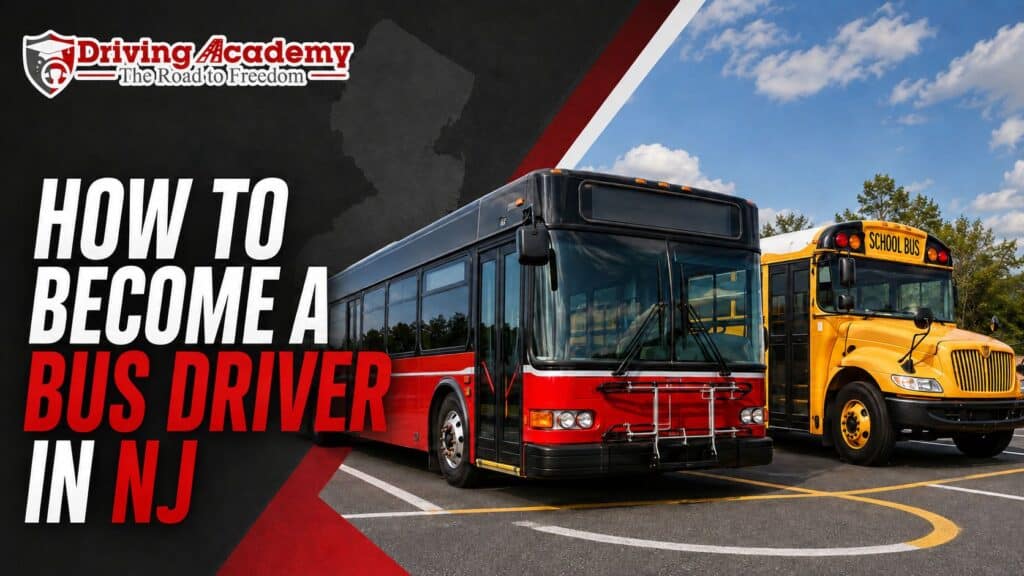
Thinking about becoming a bus or school bus driver in the Garden State?
Between choosing the right CDL class, passing the NJ MVC permit tests, completing ELDT and figuring out which endorsements you need, there is a lot to sort through before you can get behind the wheel. So the path to becoming a bus driver in New Jersey can feel confusing at first.
The good news is that you don’t have to figure it all out on your own!
At Driving Academy, we help future New Jersey bus drivers prepare for their CDL permits, required training and road tests. We also offer School Bus endorsement training and have an actual school bus at each of our New Jersey training yards, so students can prepare in the type of vehicle they’ll be tested in.
Keep reading because in this guide, you’ll learn how to become a bus driver in NJ.
If you’d rather have an experienced team help you figure it out,
our New Jersey CDL advisors are ready to help.
What CDL Do You Need to Drive a Bus in New Jersey?
- A Class B CDL covers a single vehicle with a gross vehicle weight rating of 26,001 pounds or more.
- A Class C CDL may cover a smaller passenger vehicle that doesn’t meet the Class B weight threshold but is designed to transport enough passengers to require a CDL.
The reality is, if you’re thinking about getting a Class C CDL, it’s pretty much just as easy to get a Class B. So go with that.
| Bus Type | Typical license and endorsements |
|---|---|
| Transit or city bus | Class B CDL with P endorsement |
| Charter | Class B CDL with P endorsement |
| Full-size school bus | Class B CDL with P & S endorsements |
| Shuttle or passenger van | Class C or B CDL with P endorsement |
Most full-size city, transit, charter and school buses fall within Class B. Before starting your CDL training, decide what type of bus you want to drive because that choice determines the license and endorsements you’ll need. Still comparing license options? Read our guide to the difference between a Class A and Class B CDL.
New Jersey Bus Driver Requirements
Before starting the licensing process, make sure you meet the core New Jersey requirements.
Age and driving experience
New Jersey doesn’t issue a Passenger endorsement to CDL applicants under 21. Applicants pursuing Passenger or School Bus endorsements must generally be at least 21 and have at least three years of driving experience.
This is different from an ordinary intrastate CDL. A person may qualify for some CDL privileges at 18 but still be unable to receive the Passenger endorsement needed for most bus-driving jobs.
Basic New Jersey driver’s license
You must have a valid basic New Jersey Class D driver’s license before applying for a New Jersey CDL.
Vision and medical requirements
New Jersey endorsement applicants must meet its vision requirements, including 20/40 vision in each eye and the ability to recognize red, green and amber.
New Jersey also requires Passenger endorsement holders to have a valid electronic Medical Examiner’s Certificate on file with FMCSA’s National Registry. The examination must be completed by a federally certified medical examiner.
Learn more about the vision requirement for CDL.
Driving record and employer requirements
Bus companies commonly review applicants’ driving records. Employers may establish requirements that are stricter than the minimum licensing rules, including limits on points, recent violations or preventable accidents.
Employers may also require drug testing, employment verification and additional physical or safety evaluations.
How to Become a Bus Driver in NJ: Step by Step
Step 1: Choose the type of bus job you want
- An NJ Transit or municipal bus
- A charter or motorcoach
- A school bus
- An airport, hotel or employee shuttle
- A college or campus bus
- A paratransit vehicle
Step 2: Complete your medical examination
Step 3: Begin the correct fingerprint and background-check process
The MVC has a specific process for regular Passenger endorsement applicants. Its current instructions are available in the Passenger Endorsement Fingerprint Application.
School bus applicants use a different Department of Education process. Don’t use the ordinary Passenger fingerprint service code when applying for a School Bus endorsement. Starting with the wrong process can mean paying for another background check.
Step 4: Obtain an examination test receipt
- Your New Jersey Class D license
- Six Points of ID
- Proof of address
- Proof of legal presence
- Your Social Security documentation
- The required application
- The $125 examination test receipt fee
Step 5: Receive your commercial learner’s permit
The NJ CDL general knowledge test contains 50 questions, and applicants must answer at least 80% correctly. Endorsement tests are administered separately.
Passing the required knowledge tests allows you to receive your commercial learner’s permit.
Driving Academy provides free CDL permit practice tests to help applicants prepare.
Step 6: Complete Entry-Level Driver Training
ELDT must be completed before the applicable CDL or endorsement skills test. It includes theory and behind-the-wheel requirements for Class B, Passenger and School Bus applicants.
Step 7: Train in the correct bus
Step 8: Pass the CDL skills test
- Vehicle inspection
- Basic control skills
- On-road driving
Why Become a Bus Driver in NJ?
Getting a CDL and the right endorsements takes work, so it makes sense to ask whether becoming a bus driver is worth it. For many New Jersey drivers, the career offers a strong combination of local work, different job options and a faster training path than a 4 years college degree.
Stay Closer to Home
Many bus-driving jobs are local. Unlike OTR trucking, bus drivers often finish their assigned route and return home the same day.
That can make bus driving a good career option if you enjoy professional driving but don’t want to spend several days or weeks away from home. Your exact schedule will depend on whether you work in transit, school transportation, charter service or another passenger-driving position.
Different Bus-Driving Careers
New Jersey has passenger transportation opportunities with public transit systems, school districts, private contractors, charter companies, airports, universities and other organizations.
Depending on your CDL class and endorsements, you may be able to pursue work as a:
- Transit or city bus driver
- Charter or motorcoach driver
- School bus driver
- Airport or hotel shuttle driver
- College or university bus driver
- Employee transportation driver
- Paratransit driver
Having more than one career path means you aren’t limited to working for a single type of employer.
Schedule That Fits Your Life
Bus-driving schedules vary based on the job.
Transit and charter companies may offer full-time schedules, nights, weekends and overtime. School bus positions commonly use morning and afternoon shifts, which may appeal to drivers looking for part-time work or time between routes.
Some employers may also offer benefits, retirement plans, paid time off or opportunities to move into dispatching, driver training and supervision. Always compare the complete compensation package instead of looking only at the advertised hourly rate.
Start Without a Four-Year Degree
You don’t need a four-year college degree to earn a CDL. What matters is meeting New Jersey’s licensing requirements, completing the proper training and earning the endorsements required for the bus you want to drive.
This gives you a way to train for a new career without spending several years in college before you can even begin applying for jobs.
Competitive Starting Pay and Strong Benefits
Bus driving can offer more stable income than many entry-level jobs, especially with established transit agencies, school districts and larger passenger transportation companies.
For a career that doesn’t require a four-year degree, starting pay can be attractive. Many employers also offer scheduled raises as drivers gain experience, along with opportunities to earn more through overtime, additional routes or different assignments.
For example, NJ Transit currently advertises competitive hourly pay with scheduled increases, medical coverage, paid vacation and sick time, a pension, a tax-deferred retirement plan and life insurance for its bus operators.
Not every employer offers the same package, and some school bus positions are part-time or based on split shifts. When comparing jobs, look at the hourly rate, guaranteed hours, benefits, overtime and long-term pay increases instead of focusing only on the starting wage.
How Much Do Bus Drivers Make in New Jersey?
How much a driver gets paid varies by employer, bus type, location, schedule, overtime and benefits.
The latest May 2025 state estimates from the U.S. Bureau of Labor Statistics reported median annual wages of approximately:
- $61,140 for New Jersey transit and intercity bus drivers
- $59,430 for New Jersey school bus drivers
These are occupational medians for people already working in the field, not guaranteed starting salaries. School bus positions may also use split shifts or part-time schedules, so compare hourly pay, guaranteed hours and benefits when reviewing an offer.
Current state information can be accessed through the BLS Occupational Employment and Wage Statistics tables.
Frequently Asked Questions
No. New Jersey doesn’t issue a Passenger endorsement to applicants under 21. Passenger and School Bus endorsement applicants also need at least three years of driving experience.