If you’re thinking about becoming a truck driver right now, there’s probably one question you’ve heard more than once:
“What happens when the trucks start driving themselves?”
It’s a fair question.
Autonomous trucks are already moving commercial freight on select U.S. routes. Companies like Aurora are expanding autonomous trucking operations and working toward running more freight without someone sitting behind the wheel. So yes, AI is coming to trucking.
But does that mean millions of truck drivers are about to lose their jobs?
Not any time soon.
Driverless trucks are already hauling freight, but the Bureau of Labor Statistics still projects truck driver employment to grow 4% from 2025 to 2035, to about 2.3 million jobs. AI is more likely to change what drivers do than to eliminate the job. And we’ve actually seen something similar happen before.
Thinking About Getting Your CDL?
What ATMs Can Teach Us About AI and Truck Drivers
Think about the last time you went to a bank. You probably used an ATM instead of walking up to a teller just to withdraw $100. When ATMs first became common, it seemed obvious that bank teller jobs would eventually disappear because machines could handle so much of the routine work tellers used to do.
ATMs did reduce the amount of basic cash-handling work required at each branch, but that wasn’t the end of the story. They also helped make bank branches cheaper to operate, which allowed banks to open more locations. Those additional branches still needed employees, even though each location could operate with fewer tellers than before. Economist James Bessen found that teller employment actually grew during the period he studied as ATMs became more widespread. The job also changed, with tellers spending less time counting cash and more time helping customers with accounts and other banking services.
This economic concept is known as the Jevons Paradox and it shows why automation isn’t always as simple as replacing one worker with one machine. When technology takes over one part of a job, the job itself may change instead of disappearing completely.
How Could the Same Thing Happen in Trucking?
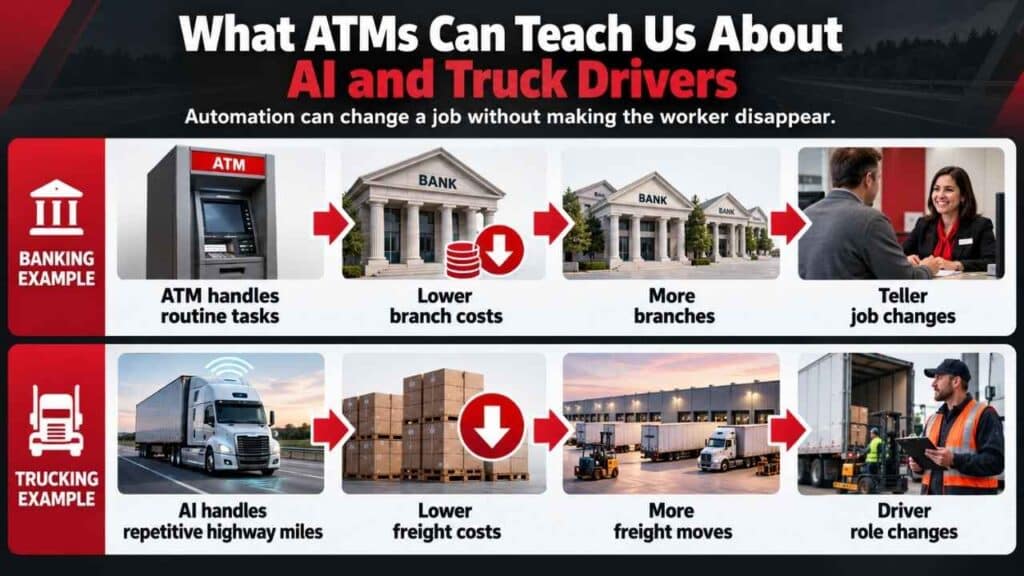
Imagine an autonomous truck can handle a long highway run more efficiently than the way freight moves today. The truck may be able to stay on the road longer, make better use of expensive equipment, and lower the cost of moving a load from one part of the country to another. At first, that sounds like bad news for truck drivers because companies could need fewer human driving hours for each shipment.
But lower transportation costs could also encourage businesses to move more freight. We’ve already seen how faster and cheaper logistics changed consumer expectations. Today, people order products online and expect them the next day, which would have seemed almost impossible 30 years ago.
If autonomous trucking makes long-distance transportation cheaper, businesses could respond by shipping more often, running additional routes, opening more warehouses, or serving customers from farther away. So the important question isn’t simply how many drivers one autonomous truck could replace. It’s how much more freight businesses might move if transportation becomes cheaper and more efficient.
There’s a Lot More to Truck Driving Than Driving
People sometimes talk about truck drivers as if the entire job is sitting behind a steering wheel for ten hours. Anyone who has actually worked around commercial trucks knows there’s much more to it.
Drivers inspect their equipment, work with warehouse employees and customers, back trailers into loading docks, secure cargo, identify problems with the truck or trailer, and figure out what to do when something doesn’t go according to plan. Those responsibilities become even more important when you move specialized freight.
A tanker driver, for example, has to understand how liquid cargo affects the vehicle. HazMat drivers may work with materials that require additional rules and safety procedures. Drivers pulling doubles and triples need additional knowledge about coupling, inspections, and how multiple trailers behave. These are not just situations where the driver follows a GPS and keeps the truck between two lines.
That could become an important advantage as trucking automates. The easiest work to automate may also be some of the most repetitive work, while specialized freight and jobs that require more judgment could continue to depend heavily on trained drivers.
Want to Explore Higher-Paying CDL Career Options?
Getting the right CDL class and endorsements can open the door to some of the highest paying trucking jobs. If you are not sure whether an endorsement makes sense for your goals, talk to one of our CDL advisors and we can help you explore which CDL path may be the best fit for the career you want.
Are Truck Drivers Still in Demand Right Now?
For someone deciding whether to get a CDL today, what is happening in the current job market matters more than trying to perfectly predict what trucking will look like 20 years from now.
According to the Bureau of Labor Statistics, the United States had about 2.2 million heavy and tractor-trailer truck driver jobs in 2025. BLS projects employment to grow about 4% from 2025 through 2035, with approximately 214,500 openings each year on average.
The important point is that current employment projections do not show truck driving disappearing. Autonomous technology is developing at the same time the industry continues to employ millions of commercial drivers.
Both things can be true.
Will CDL Training Still Matter?
Absolutely. Commercial drivers still need to know how to inspect a vehicle, safely control a large truck, back into loading areas, understand braking systems, work around other traffic, and follow commercial driving rules.
Technology may eventually take over more routine driving tasks, but that could make the skills AI struggles with even more important. Working with specialized equipment, communicating with customers, identifying mechanical problems, handling unusual freight, and making good decisions when something unexpected happens are all areas where trained drivers provide value beyond simply steering the truck.
Future drivers may also work with more automated safety systems, diagnostics, fleet software, and autonomous equipment. The CDL driver of tomorrow may need to understand both the truck and the technology built around it, which make CDL training matter even more!

So, Will AI Replace Truck Drivers?
AI will probably replace some truck-driving tasks, and certain types of driving jobs may become smaller as autonomous technology improves. But replacing the entire truck-driving occupation is a much bigger challenge.
Long highway runs are relatively predictable. Moving real freight is not. Someone still has to deal with loading docks, customers, specialized cargo, equipment issues, inspections, and all the unexpected problems that happen between pickup and delivery.
The ATM example shows why this matters. ATMs automated one of the most important tasks bank tellers traditionally performed, but the result wasn’t simply that every teller disappeared. Banks changed the way they operated, and the teller job changed with them.
Trucking could follow a similar path. The driver of the future may spend less time doing repetitive highway miles and more time handling local freight, specialized loads, customers, equipment, or automated systems.